

Remote work IT security has never been more urgent for UK businesses and the numbers make that plain: 60% of employees now admit they are willing to use unsanctioned AI tools despite the security risk, simply to meet deadlines. That single statistic captures exactly why the old approach to IT security, built for an office perimeter that no longer exists, is no longer enough to protect your business.
Key Takeaways
- Remote work fundamentally changes your attack surface. Every home router, personal laptop and unsanctioned app is a potential entry point for attackers.
- Endpoint security is the foundation. Devices used outside the office need layered, device-level protection against ransomware, phishing and data theft.
- MFA is non-negotiable. Multi-factor authentication closes the gap on stolen or weak credentials, which account for the majority of remote-work breaches.
- 24/7 monitoring matters more than ever. Threats don’t follow business hours and neither does our Security Operations Centre.
- Human behaviour is your biggest vulnerability. Phishing simulations and security awareness training reduce the risk that one click brings down your whole operation.
- Strategic security leadership requires a plan, not just tools. A virtual CISO gives your business expert guidance without the full-time executive overhead.
- Data protection and compliance do not stop at the office door. Encryption, access controls and data loss prevention must follow your data wherever it travels.
Why Remote Work IT Security Can No Longer Be an Afterthought
In 2026, distributed teams are the norm rather than the exception. With that shift comes a dramatically expanded attack surface that most businesses are still catching up to protect.
At ITERTECH, we take time to understand our clients’ problems and challenges. What we see again and again is that businesses have moved their people to remote or hybrid working without moving their security posture to match.

The challenge is not simply technical. It is behavioural, structural and strategic all at once. Employees working from home use personal routers, personal devices and personal judgement about which apps are safe to use.
92% of IT specialists believe that the adoption of full remote and hybrid work has a direct impact on the increase of cybersecurity threats. That near-unanimous expert consensus is not fear-mongering; it is a realistic assessment of what happens when corporate data leaves the corporate perimeter.
This guide breaks down the best services and approaches for remote work IT security, so your business knows exactly what to prioritise and why.
Best for Endpoint Security: Protecting Every Device in Your Remote Workforce
When your team works from home, their laptops, tablets and phones are the new perimeter. Endpoint security provides layered protection directly at the device level, regardless of where that device is located.
Our endpoint security solutions guard against ransomware, phishing and data loss using device-level controls and continuous monitoring. These are integrated with cloud services so protection travels with the device, not just the office network.
For remote and hybrid teams, this means every laptop checking into a client meeting from a coffee shop and every phone accessing company email from home, carries the same robust defences as if it were sitting inside your office.
- Ransomware and malware prevention at the device layer, before threats reach your network
- Device encryption through solutions like BitLocker to guard against physical theft
- Ongoing monitoring that flags anomalous behaviour in real time
Best for Remote Work IT Security Monitoring: A Dedicated Security Operations Centre
A Security Operations Centre (SOC) provides the kind of continuous, eyes-on coverage that remote work demands. Threats do not respect business hours and your security monitoring should not either.
Our SOC correlates signals across endpoints, networks and cloud services to identify suspicious activity as it happens. Proactive threat hunting and rapid incident response mean that when something does go wrong, the damage is contained quickly and your team keeps working.
For businesses with remote or hybrid staff, SOC monitoring is one of the most effective investments in remote work IT security available. It closes the visibility gap that opens up when people work outside a supervised office environment.

Best for Credential Protection: MFA and Identity Access Management
More than six in ten security breaches trace back to weak or stolen credentials. In a remote work environment, where employees log in from dozens of different locations and devices, the risk of credential compromise is significantly higher than in a controlled office setting.
Multi-factor authentication (MFA) adds a critical extra layer of verification that a stolen password alone cannot bypass. Our MFA solutions support SMS codes, authenticator apps and hardware keys, so your remote workforce has strong, flexible authentication that works for them without creating friction that tempts people to find workarounds.
Alongside MFA, identity and access management (IAM) gives your organisation granular control over who can access what, from where and when. Role-based permissions, single sign-on (SSO) and ongoing governance reduce your exposure dramatically, especially for remote teams accessing sensitive systems and data from home networks.
- MFA across all users and access points, with policy-driven deployment
- Role-based access controls to limit exposure if one account is compromised
- Single sign-on (SSO) for a secure, streamlined login experience for remote workers
- Access governance and regular reviews to catch stale permissions before attackers do
Best for Network Security in Remote Work Environments
38% of all cyberattacks targeted home routers, VPNs and other remote-access methods in recent reporting periods. Your employees’ home networks are now the front line of your corporate defence and most of those networks were never designed for that role.
Our managed network security services defend your perimeter with managed firewalls, VPNs and continuous threat detection across both on-premises and cloud environments. We monitor and respond to suspicious activity around the clock so that a compromised home router does not become a compromised business.
We also offer network penetration testing and web application firewall services for businesses that need to go deeper and test their own defences before attackers do.
- Managed firewalls configured and updated to reflect current threat intelligence
- Secure VPN access for remote employees connecting to corporate resources
- 24/7 threat detection and alerting across all network traffic
- Vulnerability scanning to identify weaknesses before they are exploited
Best for Security Awareness: Phishing Simulations and Staff Training
73% of remote employees admit to using personal devices for work purposes and those devices are rarely protected to the same standard as corporate-issued equipment. That gap in protection combines with a gap in awareness to create exactly the conditions that phishing attacks are designed to exploit.
Our phishing simulation and security training service tests your team’s real-world response to social engineering attacks, then uses the results to drive targeted education. Campaigns are tailored to reflect your industry and threat landscape, so training feels relevant rather than generic.
Reducing human error in your remote workforce is one of the highest-return investments you can make in remote work IT security. Our security awareness training programmes build lasting habits, not just one-off compliance checkboxes.
Best for Data Protection Across Distributed Teams

Data security becomes significantly more complex when your team is spread across home offices, co-working spaces and client sites. Files shared over personal email, cloud apps used without IT approval and devices that leave the building all create new vectors for data loss.
Our data security services cover encryption, access control, cloud backups and data loss prevention (DLP), providing comprehensive protection for data wherever it travels. We also support data protection compliance and lifecycle monitoring, so your business stays on the right side of regulatory obligations as well as security best practice.
For businesses dealing with particularly sensitive data, our data loss prevention and SIEM and SOAR capabilities give you forensic-level visibility into how data moves across your environment.
Best for Strategic Remote Work IT Security Leadership: Virtual CISO Services
Most SMBs do not have the budget or the need for a full-time Chief Information Security Officer. But every business that handles sensitive data, employs remote workers or operates in a regulated industry needs the kind of strategic security leadership a CISO provides.
As James, our Managing Director, puts it: “In an ideal world with an unlimited budget, we would have the best tech, but this is not an ideal world, so implementation and intelligent application of security technologies and processes should be used to mitigate current and emerging threats in the context of the business.”
Our virtual CISO services give your business access to senior-level security expertise on a flexible, cost-effective basis. We work with your leadership team to build a security strategy that reflects your actual risk appetite, your budget and your operational realities as a distributed business.
This is not about securing everything blindly. It is about intelligent, prioritised security that protects what matters most and gives your executive team the confidence to make informed decisions.
Best for Ongoing Remote Work IT Security Support: Outsourced IT
Remote workers need reliable, responsive IT support just as much as office-based staff do and often more so because they are working without the informal safety net of an IT team down the corridor.
Our outsourced IT support provides your business with a full IT function, including security management, helpdesk support and proactive monitoring, without the overhead of an in-house team. For growing businesses and SMBs, this is frequently the most practical and cost-effective route to strong remote work IT security.
When something goes wrong for a remote worker, fast resolution matters enormously. Our remote IT support services use secure, encrypted connections and RMM (Remote Monitoring and Management) technology to troubleshoot and resolve issues without needing an on-site visit, minimising downtime and keeping your remote team productive.
Our commitment to excellence allows you to focus on business growth, confident in the reliability and innovation of our services. This is why we are the ones you want handling your technology.
Shadow IT, Shadow AI and the Hidden Risks of Remote Work
One of the fastest-growing threats to remote work IT security in 2026 is not a sophisticated nation-state attack. It is your own employees using tools your IT team cannot see or protect.
80% of employees use SaaS applications without obtaining IT permission, while 67% have brought personal tools into work environments. When those unseen applications handle sensitive data, they create regulatory and security exposure that your existing controls cannot address.
Shadow AI compounds this further. Employees feeding confidential client data into consumer AI tools, sharing proprietary information through personal accounts or bypassing approved workflows to use faster alternatives are all creating liabilities that most businesses have not yet accounted for in their security posture.
At ITERTECH, we help businesses map their actual technology usage, not just the tools on the approved list and build policies and controls that reduce shadow IT risk without stifling productivity.
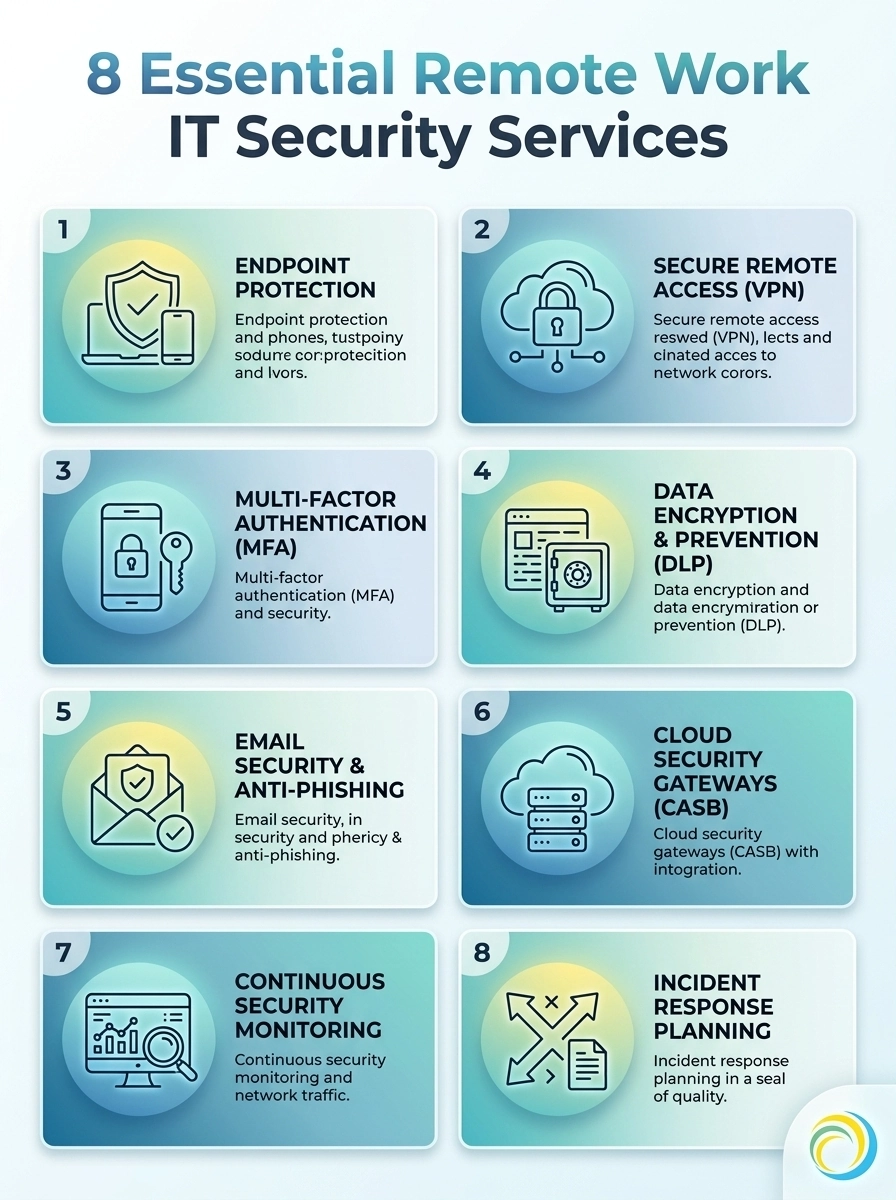
A concise visual guide to the eight core IT security services that support secure remote work. Use this infographic to prioritize safeguards for distributed teams.
How to Choose the Right Remote Work IT Security Approach for Your Business
Not every business needs every service listed here and not every security investment delivers the same return in every context. The right approach to remote work IT security depends on your size, your data, your industry and the maturity of your current IT environment.
At ITERTECH, we take time to understand our clients’ problems and challenges. These are crucial for delivering effective solutions that meet their unique needs and drive successful outcomes.
Our implementation process is swift, thorough and methodical. We do not arrive with a templated security stack and ask your business to fit around it. We start by understanding your actual risk exposure, your team’s working patterns and your appetite for disruption during any transition.
As a starting framework, businesses should consider prioritising in this order:
- MFA and identity access management (closes the credential breach gap immediately)
- Endpoint security (protects the devices your remote workers actually use)
- Security awareness training and phishing simulations (addresses the human factor)
- Network security and VPN (secures the connections between remote workers and corporate systems)
- SOC monitoring (provides the ongoing visibility that makes all other controls meaningful)
- Virtual CISO (gives your security programme strategic direction and governance)
Remote work IT security is not a single product you can buy or a one-time project you can complete. It is an ongoing practice that needs to evolve as your team, your tools and your threat landscape change.
The businesses that get this right are the ones that treat remote work IT security as a business priority, not just an IT concern. They invest in the right mix of technology, process and human awareness. They work with a trusted IT partner who understands their specific context, not just a vendor selling a standard stack.
At ITERTECH, we are eager to learn about your needs and discuss how our services can help your business thrive. Whether you need proactive monitoring, strategic security leadership, staff training or day-to-day remote IT support services, we are ready to help you build a security posture that gives your team the freedom to work from anywhere without giving attackers an open door.
Our commitment is to take the stress out of IT and deliver the peace of mind that comes from knowing your business is genuinely protected, wherever your people are working.
Frequently Asked Questions
What are the biggest remote work IT security risks in 2026?
The biggest risks include credential theft through phishing and weak passwords, unsecured home networks being used to access corporate systems, shadow IT (employees using unsanctioned apps) and personal devices handling sensitive business data. Research in 2026 confirms that 92% of IT specialists believe remote and hybrid work directly increases cybersecurity threats.
How do I improve remote work IT security for my small business?
Start with multi-factor authentication across all accounts, then implement endpoint security on all devices used for work. Combine this with regular phishing simulations and security awareness training and consider outsourced IT support to maintain proactive monitoring without the overhead of an in-house team.
Is a VPN enough for remote work IT security?
A VPN is one important layer, but it is not sufficient on its own. Effective remote work IT security requires a combination of endpoint protection, MFA, network security, identity access management and ongoing monitoring. A VPN protects the connection, but does nothing to protect a device that is already compromised.
What is a virtual CISO and does my business need one?
A virtual CISO (vCISO) provides senior security leadership and strategy on a part-time or fractional basis, making it accessible and cost-effective for SMBs. If your business handles sensitive data, operates in a regulated sector or has a distributed workforce, a virtual CISO helps you build a coherent, prioritised security programme rather than reacting to threats after the fact.
How much does remote work IT security cost for an SMB?
Costs vary depending on the size of your team, the complexity of your environment and the services you need. Outsourced IT support packages often bundle security monitoring, endpoint protection and helpdesk support into a single monthly fee, which is typically far more cost-effective than building the same capability in-house. Contact ITERTECH for a tailored assessment and pricing specific to your business.
What is Shadow IT and why is it a remote work security problem?
Shadow IT refers to software, apps and services used by employees without IT department knowledge or approval. In a remote work environment, employees are more likely to reach for personal tools to get their job done, which means sensitive data regularly flows through systems your security controls cannot see or protect. Addressing shadow IT requires both policy and technical controls.
How can I tell if my remote workers are a security risk right now?
Vulnerability scanning, endpoint monitoring and phishing simulations can all surface real weaknesses in your current remote work IT security posture. A SIEM and SOAR platform combined with SOC monitoring provides continuous visibility into anomalous behaviour across your environment. At ITERTECH, we can run an assessment to give you a clear picture of your current exposure before any incident occurs.