

Phishing Simulations
Employees can unknowingly expose sensitive information or compromise entire systems with a single misplaced click. Phishing simulations identify these weaknesses before criminals can exploit them, helping teams recognise and respond to threats confidently.
Our phishing simulation services have helped organisations reduce risk and improve employee confidence through practical awareness training. Clients have seen measurable reductions in click rates on simulated phishing emails after just one campaign and tailored reporting highlights individual and departmental performance, making it easier to focus on areas that need attention.

Phishing Simulations Made Easy
Our phishing simulations are designed to make cybersecurity awareness effortless and effective. From planning to reporting, every step is managed for you, removing the need for technical input or additional resources. Each campaign uses realistic, industry-specific examples to engage staff and highlight real-world risks. Clear dashboards and detailed feedback turn every test into an opportunity for growth, helping teams build lasting confidence in spotting suspicious emails.
Clients value how seamlessly the process fits into their routine operations. Automated scheduling, performance insights and tailored guidance ensure that awareness training remains consistent and measurable.
Phishing Simulations with ITERTECH

Awareness
Phishing simulations help employees recognise suspicious emails and online threats before real damage occurs. Regular testing builds awareness, sharpens judgement and encourages a proactive approach to identifying and reporting cyber risks.

Prevention
By identifying weaknesses before criminals do, phishing simulations reduce the risk of successful attacks. Continuous training strengthens defences, ensuring employees become a key line of protection rather than a point of vulnerability.

Compliance
Regular phishing simulations support compliance with data protection and cybersecurity standards. Demonstrating proactive employee training helps meet regulatory obligations, reduces audit risk and strengthens your organisation’s overall security posture and governance framework.
Get Started with Phishing Simulations
Give ITERTECH a call to see if Phishing Simulations are right for you and your business.

The technology behind Phishing Simulations
Architecture
Our phishing simulation platform is built on a scalable, cloud-native architecture designed for flexibility, resilience and integration. This modular approach ensures that each function can be updated or scaled individually without disrupting active campaigns or data flow.
The email delivery service operates using secure SMTP relay systems with full SPF, DKIM and DMARC compliance. It employs domain-spoofing control to simulate real-world phishing conditions safely, while integration with mail gateways and API connectors ensures compatibility with major email clients such as Microsoft 365 and Google Workspace. Load balancing and fault-tolerant clusters support large-scale simulations with minimal latency.
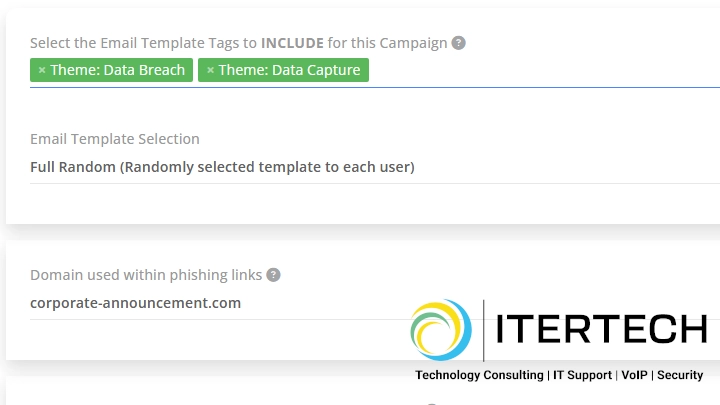

Template Engine
The template engine is the creative core of a phishing simulation platform, responsible for generating convincing, varied and data-driven scenarios. It uses dynamic fields and conditional logic to personalise each message, mirroring real-world phishing attempts. By drawing on live data sources such as user names, departments and job titles, the system crafts authentic-looking content that challenges even vigilant employees.
Templates can include HTML and CSS styling, embedded media and responsive layouts that render correctly across devices. The system supports multi-language content and A/B variant testing to measure which techniques are most effective at eliciting responses.
Behavioural Analytics
Every user interaction, such as opening an email, clicking a link or submitting data, is captured and timestamped for analysis. This granular insight allows organisations to identify behavioural patterns, such as habitual clickers or rapid responders, which often indicate higher risk profiles. The system’s ability to track these behaviours helps fine-tune both individual and company-wide training efforts.
The analytics assesses metrics including reaction time, report accuracy and susceptibility trends across multiple campaigns. These datasets are visualised in dashboards that show real-time performance and progression, making it easier for security managers to prioritise resources and justify training investments.

More Than Just Phishing Simulations
Many of our clients who use us for Phishing Simulations also benefit from a variety of complementary services designed to optimise performance, protect data and support growth.
Explore these additional solutions now to strengthen your IT infrastructure and stay ahead of the curve.

Security Training
Security training helps employees recognise and prevent online threats that can compromise business data. It builds awareness of phishing, malware and password risks, with accessible, engaging lessons to help teams gain the confidence to handle sensitive information safely.

Endpoint Security
Without strong endpoint security, even a single compromised device can expose sensitive information and disrupt productivity.

SIEM and SOAR
SIEM and SOAR provide the intelligence and automation needed to detect, analyse and respond to threats quickly.

CISO Services
CISO Services provide expert leadership, strategy and governance to strengthen security posture and ensure long-term resilience.
Phishing Simulations FAQs
Do you still have questions about Phishing Simulations? We’ve answered the most frequent questions that we’re asked below!
What Are Phishing Simulations?
Phishing simulations are controlled cybersecurity exercises that imitate real phishing attacks to test how people respond. They are designed to help organisations understand how vulnerable their staff may be to deceptive emails or messages that aim to trick recipients into sharing information, downloading files or clicking unsafe links. These simulations are completely safe and do not cause harm but provide valuable data on how employees behave when faced with a realistic threat.
During a phishing simulation, messages are sent to selected users that look genuine but have subtle signs of phishing—such as slightly altered sender addresses, urgent requests or links that lead to mock login pages. When users open these messages, click a link or attempt to enter information, their actions are recorded for analysis. The simulation might also track whether employees report the suspicious email to their IT or security team. All of this data helps measure awareness and highlight areas where extra guidance may be useful.
The results of phishing simulations are usually presented in detailed reports that show click rates, reporting rates and overall improvements across multiple campaigns. This helps organisations see patterns in user behaviour and tailor future training to address the most common risks. For example, if many employees click links that appear to come from a trusted supplier, future sessions can focus on verifying sender details and spotting red flags.
Phishing simulations form an important part of wider security awareness programmes. They teach employees how to pause, assess and verify before acting on an unexpected message. By creating a realistic but risk-free experience, these exercises prepare users for real-world threats in a way that policies or presentations alone cannot. Over time, repeated simulations help build a stronger security culture, making people more confident and alert when facing suspicious emails in their day-to-day work.
How Do Phishing Simulations Work?
Phishing simulations work by safely recreating the methods used in real phishing attacks to test how people respond. They begin with a controlled setup where an organisation designs or selects mock phishing messages to send to its staff. These messages are built to look realistic, often copying styles used by known brands or internal departments, but they are entirely safe. The purpose is to observe behaviour, not to expose sensitive data.
Once the campaign begins, employees receive these simulated phishing emails in their usual inboxes. The emails might contain links to fake websites, urgent requests for login details or attachments that seem genuine. When recipients interact with the message—such as clicking a link or submitting information—the system records the action. If someone reports the email as suspicious, that response is also tracked. This allows organisations to measure who recognised the threat, who engaged with it and how long it took to respond.
The platform behind the simulation gathers this data in real time and produces reports showing how individuals and teams performed. Security teams can view click rates, reporting rates and common response patterns. Some systems also offer “teachable moments,” where users who click a link are redirected to a short awareness page explaining what clues they missed. This immediate feedback helps people learn from mistakes in a practical and memorable way.
Over time organisations can run follow-up campaigns using different themes or difficulty levels to measure improvement. The data collected helps track progress and shape future awareness training. Simulations can be tailored to reflect current phishing trends—such as fake delivery notices, account alerts or cloud service messages—making them more realistic and effective. When used regularly, phishing simulations provide an accurate picture of how ready employees are to detect and report real phishing attempts, improving resilience across the business.
Why Are Phishing Simulations Important?
Phishing simulations are important because they help organisations reduce one of the most common causes of security breaches—human error. Many cyber incidents begin when someone clicks a malicious link, opens a fake attachment or enters login details on a fraudulent website. Phishing simulations create a safe environment to test and improve how employees handle these situations. By turning potential mistakes into learning opportunities, they strengthen awareness and reduce the likelihood of real-world attacks succeeding.
One of the main benefits of phishing simulations is that they provide measurable insight into staff behaviour. Instead of assuming employees understand phishing risks organisations can see real data on how people respond to different scenarios. Reports often include click rates, reporting rates and how responses improve over time. This information allows teams to focus training where it’s needed most, rather than applying the same approach to everyone. It also provides evidence of progress that can be shared with management or auditors.
Phishing simulations also help build a culture of security across the organisation. When people regularly encounter realistic but harmless examples of phishing, they learn to be cautious without becoming fearful. This approach encourages staff to double-check suspicious messages and report them quickly, which improves overall incident response. Over time, employees become more confident in recognising scams and take greater responsibility for protecting company information.
From a compliance perspective, phishing simulations support requirements in data protection and cybersecurity frameworks. Many standards, including ISO 27001 and GDPR, expect organisations to show they are actively managing risk and promoting security awareness. Running regular simulations demonstrates due diligence and helps maintain a strong defence posture. In essence, phishing simulations combine education, measurement and prevention in one practical process, making them an essential part of any modern security strategy.
How Often Should Phishing Simulations Be Run?
Phishing simulations should be run regularly enough to keep awareness high but not so often that they become predictable. Most cybersecurity experts recommend running them every one to three months, depending on the organisation’s size, risk profile and industry requirements. This frequency helps maintain engagement while providing enough data to measure improvement and spot trends in behaviour. In high-risk sectors such as finance or healthcare, monthly campaigns are often preferred to keep staff alert against evolving threats.
Running simulations too rarely can lead to a decline in vigilance, as employees forget what they learned or become complacent. On the other hand, excessive testing can cause “alert fatigue,” where staff stop taking the exercises seriously. The goal is to find a balance that reinforces good habits without overwhelming people. Many organisations vary the timing and style of each campaign to keep them unpredictable, ensuring users remain attentive when new messages arrive.
It’s also useful to link the simulation schedule with broader awareness initiatives. For example, a company might run a phishing test at the start of Cybersecurity Awareness Month, followed by short refresher training based on the results. Others may use simulation data to adapt training frequency—running more tests in departments that show higher click rates or reduced reporting activity. This adaptive approach keeps simulations relevant and effective over time.
Ultimately, the ideal frequency depends on organisational needs and the maturity of its security culture. A company just beginning awareness training may benefit from quarterly simulations while it builds a baseline. More mature teams can maintain monthly testing to sustain high awareness. Regardless of schedule, consistency is key: phishing simulations are most effective when they form part of an ongoing, data-driven programme rather than a one-off exercise.
Are Phishing Simulation Emails Safe?
Phishing simulation emails are completely safe when run through a legitimate awareness platform or managed by a trained security team. They are designed to mimic the appearance and behaviour of real phishing attempts—such as urgent requests, spoofed branding or suspicious links—but they never contain malicious code or harmful attachments. Every link and attachment within a simulation is either disabled or redirects to a secure training environment, ensuring that no real threat is introduced to the organisation’s systems.
These controlled exercises are carefully planned to test awareness, not to compromise security. When a user clicks a link or enters credentials on a simulated page, the system simply records the interaction. It does not capture personal data or transmit information externally. In most setups, the system immediately provides educational feedback, explaining how the message could have been identified as a phishing attempt. This “safe failure” approach allows staff to learn from mistakes without risk or embarrassment.
Phishing simulations are also developed under strict privacy and data protection guidelines. Results are usually anonymised or aggregated so individual employees are not singled out. The purpose is to assess collective risk levels and tailor awareness training, not to penalise users. Security teams or awareness managers typically ensure the content, frequency and reporting structure follow internal policies and legal requirements.
Overall, phishing simulation emails serve as realistic but harmless replicas of genuine threats. They train employees to spot and report phishing attempts before real attackers can succeed. By maintaining full control over every message and outcome organisations can strengthen defences safely and ethically while protecting both users and systems from any actual compromise.
