
When it comes to remote vs on-site IT support, the decision your business makes will shape how quickly issues get resolved, how much you spend and how well your team stays productive. Research from Unthread in 2026 shows that distributed support teams are approximately 13% more productive than their on-site counterparts, which tells you a great deal about how the IT support landscape has shifted in recent years.
Key Takeaways
- Remote IT support resolves most issues faster and at lower cost, making it the default best choice for SMBs with cloud-based infrastructure.
- On-site IT support remains essential for hardware failures, physical installations and environments where security or compliance requires in-person oversight.
- A blended model combining remote monitoring with on-site capability gives businesses the best of both worlds and it is what ITERTECH recommends for most SMBs.
- Cost difference is significant: on-site visits often carry surcharges on top of standard rates, while remote support is typically covered within a fixed monthly plan.
- Response times are generally faster with remote support, as engineers can connect instantly without travel time factoring in.
- Security considerations differ: remote support requires secure access protocols, while on-site support introduces different physical access and chain-of-custody considerations.
- For a full breakdown of how outsourced IT support works for SMBs, including remote and on-site options, our definitive guide covers everything you need to know.
What Is Remote IT Support?
Remote IT support is exactly what it sounds like: an engineer connects to your systems over a secure internet connection and resolves issues without needing to be physically present in your office.
This is done using Remote Monitoring and Management (RMM) software, which allows IT teams to see your systems in real time, apply patches, diagnose problems and fix them, all without interrupting your workflow.
At ITERTECH, our remote IT support services cover businesses across Surrey, Berkshire and Hampshire. Whether your team is in the office or working from home, our engineers can connect, investigate and resolve most issues within minutes of a ticket being raised.

The convenience factor is significant. Remote support removes travel time completely, which means your issue gets attention the moment it is logged, not 45 minutes later when an engineer has managed to navigate the M25.
What Is On-Site IT Support?
On-site IT support involves an engineer physically attending your premises to diagnose and resolve a problem. This is necessary in specific situations that cannot be handled remotely.
Common examples include hardware replacements, server room work, network infrastructure installation, physical cabling and any scenario where a hands-on assessment is required.
On-site support also plays an important role in certain regulated industries where physical presence is required for audit trails or compliance documentation. It is not obsolete, but it is best understood as a targeted tool rather than a default approach.
At ITERTECH, our team covers the full South East, including Surrey, Basingstoke and Reading in Berkshire, so when an on-site visit is needed, we can get there promptly.
Remote vs On-Site IT Support: The 3 Key Differences
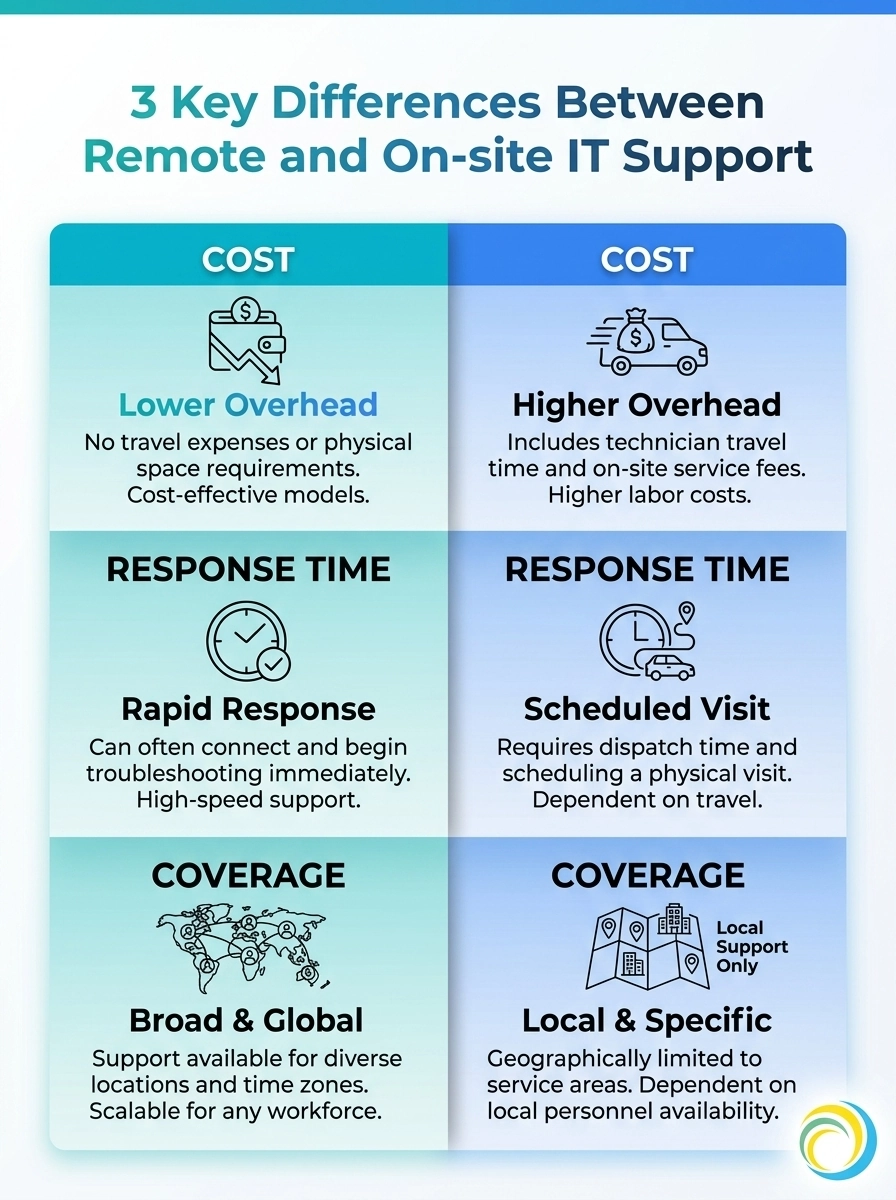
This infographic highlights the 3 key differences between remote and on-site IT support. It helps teams decide which model fits their needs.
Understanding the core distinctions between these two models helps you make a practical, realistic decision for your business. The three biggest differences come down to speed, cost and scope of resolution.
| Factor | Remote IT Support | On-Site IT Support |
|---|---|---|
| Response Time | Immediate (no travel) | Delayed by travel time |
| Cost | Lower (included in fixed plans) | Higher (surcharges apply) |
| Scope | Software, cloud, configuration, access | Hardware, cabling, physical infrastructure |
| Availability | 24/7 monitoring possible | Business hours typically |
| Best For | Day-to-day support, cloud issues, user errors | Hardware failures, installations, network builds |

Best for Cost: Remote vs On-Site IT Support
If cost is a primary concern for your business, remote support wins this comparison clearly. According to Lucent Phone’s IT pricing guide, on-site IT support visits typically carry a surcharge of $25 to $75 per visit in the USA on top of standard hourly rates. For the UK and particularly in London, these surcharges can be much higher, averaging £150 or more and that cost compounds quickly if your business relies on frequent engineer attendance.
Remote support is almost always priced as part of a fixed monthly managed service plan. That means you know exactly what you are paying, regardless of how many issues arise in a given month. No surprises. No per-visit invoices landing at the end of the quarter.
For small and medium-sized businesses watching their IT budget carefully, this predictability is genuinely valuable. Taking the complexity and headache out of your IT costs is part of what we do every day at ITERTECH.

On-site support is not something to eliminate entirely. But it should be triggered by genuine need, not habit. When on-site visits are reserved for hardware work and installations, your overall support costs reduce significantly.
Best for Speed and Response Time: Remote vs On-Site IT Support
When a member of your team cannot log in or your email server goes down mid-morning, every minute counts. Remote IT support wins on speed in almost every scenario that does not require a physical fix.
A remote engineer can be connected to your system within minutes of a support ticket being raised. There is no traffic, no parking, no building access delays. The issue gets worked on immediately.
On-site support introduces a delay that is difficult to avoid. Even with the fastest response commitment, an engineer travelling from across Surrey or Hampshire will add 30 to 90 minutes before a resolution even begins. For time-sensitive business operations, that is a meaningful disruption.
Our remote IT support service is built around fast response times, with proactive monitoring that often catches and resolves issues before you have even noticed them.
Best for Security: Remote vs On-Site IT Support
Security is a topic that deserves careful consideration in the remote vs on-site IT support conversation. Both models carry their own security implications and the right answer depends on your industry and existing infrastructure.
Remote support, when properly configured, uses encrypted connections, multi-factor authentication and session logging to ensure every access event is traceable and auditable. Our team connects through hardened, monitored channels, not ad-hoc consumer tools.
On-site support brings physical access considerations. Every visitor to your premises with access to IT equipment represents a chain-of-custody requirement, particularly in regulated industries. Proper access management and documented visit logs are essential.
For businesses that need a strategic view of their security posture across both remote and physical environments, our cyber security services and virtual CISO services provide the oversight needed to keep both models operating safely.
The key takeaway here: remote support is not inherently less secure than on-site support. It simply requires different controls and those controls need to be actively managed and monitored.
Best for Remote vs On-Site IT Support: Industry and Workflow Scenarios
The best model for your business is determined by what your operations actually look like day to day. Here is how the remote vs on-site IT support comparison plays out across common SMB scenarios.
- Hybrid and remote-first teams: Remote IT support is the clear winner. Engineers can assist staff wherever they are working, with no dependency on physical location.
- Office-based businesses with physical servers: A blended model is best. Remote support handles day-to-day issues, while on-site cover is reserved for server maintenance and hardware work.
- Businesses undergoing IT infrastructure changes: On-site involvement is important during migrations, office moves or network builds. Remote support handles everything after the physical work is complete.
- Regulated industries (finance, healthcare, legal): Compliance requirements may dictate aspects of both models. A managed approach with documented processes across remote and on-site access is essential.
- Multi-site businesses: Remote support scales effortlessly across locations. On-site resources need to be distributed or contracted regionally.
This case study perspective shows the transformative power of remote IT support, demonstrating how it can help businesses adapt quickly to changes and stay productive even during big disruptions. When a business transitions to hybrid working and can maintain full IT support coverage without an engineer in every office, that is a meaningful operational advantage.
Best for SMBs in 2026: Why a Blended Model Wins the Remote vs On-Site IT Support Debate
If you are running a small or medium-sized business in 2026, the honest answer to the remote vs on-site IT support debate is: you need both, but in the right proportions.
Remote support should be your primary, day-to-day model. It is faster, more cost-effective and scales easily as your team grows or changes location. Proactive monitoring through RMM software means many problems are caught and resolved before your team even notices.
On-site support should sit behind that as a scheduled or triggered resource, available when physical intervention is genuinely required. Planned visits for hardware audits, infrastructure checks and installations make on-site support a structured part of your IT calendar rather than a reactive scramble.
This blended approach is what we recommend to the SMBs we work with across London and Surrey. It takes the stress out of IT without leaving your business exposed when something physical needs hands-on attention.
Our IT support service is built around exactly this model: remote monitoring and management as the backbone, with on-site cover available when it is needed. Every step is managed for you, removing the need for technical input or additional resources from your side.
How ITERTECH Approaches Remote vs On-Site IT Support
At ITERTECH, we take the stress out of IT for small and medium-sized businesses across London and Surrey. Our approach to remote vs on-site IT support is built around what your business actually needs, not a one-size-fits-all package.
We handle everything: from IT support and cloud services to cybersecurity, network management and much more, so you can focus on running your business, not fighting tech issues.
Here is what that looks like in practice:
- Proactive remote monitoring: Your systems are watched 24/7, with alerts configured to catch issues before they become problems.
- Fast remote resolution: Most support tickets are resolved remotely within the same working day, often within the hour.
- Scheduled on-site visits: Hardware checks, infrastructure audits and planned installations are handled by our engineers attending your site at agreed times.
- Emergency on-site response: When something physical fails and cannot wait, we dispatch an engineer to your premises without delay.
- Jargon-free communication: Every interaction is explained clearly, so you always know what we are doing and why.
We pride ourselves on being the reliable, behind-the-scenes IT heroes our clients count on, delivering proactive solutions, fast response times and jargon-free support. It is technology you can trust and a partnership you will love.
If you would like to talk through your options, our team at ITERTECH is ready to help you cut through the complexity and build a practical, realistic plan for your IT support model. You can also explore our full IT services offering to understand the complete range of support available to your business.
Remote vs On-Site IT Support Summarised
The remote vs on-site IT support debate does not have a single winner, but it does have a clear direction for most businesses in 2026. Remote support is faster, more affordable and more scalable. On-site support remains irreplaceable for physical infrastructure work and hardware-specific issues.
The businesses that get the most value from their IT support are those that use remote support as their primary model and deploy on-site resources strategically, when the situation genuinely calls for it.
If you are an SMB in Surrey, Berkshire or Hampshire looking to move away from reactive IT headaches and toward a proactive, managed approach, ITERTECH is ready to help. Give us a call and we will walk you through exactly which model, remote, on-site or a blended combination, is right for where your business is today and where it is heading next.
Our goal is to provide services that offer a proactive and reliable IT experience. Read our definitive guide to outsourced IT support for SMBs to understand how a fully managed approach can transform the way your business handles technology.
Frequently Asked Questions
What is the main difference between remote and on-site IT support?
Remote IT support is delivered over a secure internet connection, with engineers resolving issues without visiting your premises. On-site IT support involves an engineer attending your location physically to diagnose or fix a problem, which is necessary for hardware failures, infrastructure installations and network cabling work.
Is remote IT support as good as on-site IT support for most businesses?
For the vast majority of day-to-day IT issues, remote support is equally effective and significantly faster, since there is no travel delay. On-site support remains essential for physical hardware problems that cannot be resolved remotely, but most SMBs find that remote support handles well over 80% of their IT issues without any need for a site visit.
How much cheaper is remote IT support compared to on-site IT support?
Remote IT support is typically included within a fixed monthly managed service plan, while on-site visits often attract additional surcharges averaging £150 per visit on top of standard hourly rates. Over a year, businesses that rely heavily on on-site support pay considerably more than those using a remote-first model.
Is remote IT support secure enough for my business data?
Yes, provided it is delivered through properly configured, encrypted tools with multi-factor authentication and session logging in place. At ITERTECH, our remote support connections are hardened and monitored, with every session traceable for audit purposes. The key is ensuring your IT provider uses enterprise-grade remote access tools rather than consumer-level alternatives.
When should a business choose on-site IT support over remote support?
On-site IT support is the right choice when a problem involves physical hardware such as a failed server, damaged networking equipment, a cabling issue or a new infrastructure installation. It is also appropriate when your industry’s compliance requirements mandate in-person oversight or when a detailed physical audit of your IT environment is required.
Can remote and on-site IT support work together for one business?
Absolutely and this blended model is what most SMBs benefit from most. Remote support handles the daily volume of IT issues quickly and cost-effectively, while on-site resources are deployed for scheduled hardware work and the occasional physical emergency. This combination gives your business the speed of remote support without losing the capability of hands-on intervention when it is genuinely needed.
Is remote IT support worth it in 2026 for a small business?
Remote IT support is not just worth it for small businesses in 2026, it is arguably the most practical and cost-effective IT support model available. With proactive monitoring, fast resolution times and predictable monthly pricing, remote-first support removes the financial unpredictability of break-fix on-site models while keeping your team productive and your systems secure.