
Understanding the true outsourced IT support cost is one of the most important decisions your business will make this year. Before you sign anything, consider this: setup fees alone for outsourced help desk services can range from £2,000 all the way to £160,000 before a single support ticket is ever handled. That hidden “start-up tax” catches a huge number of small and medium-sized businesses completely off guard and it’s just one of the reasons you need a clear, structured approach to evaluating what you’re actually paying for.
Key Takeaways
| Question | Answer |
|---|---|
| How much does outsourced IT support cost in the UK? | Typically between £30 and £150 per user per month in 2026, depending on service scope, provider and business size. |
| What pricing models are available? | Per-user monthly, per-device, per-ticket, tiered packages and PAYG (pay-as-you-go) are the most common structures. |
| Is outsourced IT support cheaper than in-house? | For most SMBs, yes. Businesses often save over 30% compared to maintaining a dedicated internal IT team when you factor in salary, benefits and training. |
| What is included in outsourced IT support? | Most managed packages include helpdesk access, proactive monitoring, security management, patch updates and reporting, with some providers adding disaster recovery and compliance tools. |
| What hidden costs should I watch for? | Setup fees, out-of-scope charges, hardware costs and escalation fees can all inflate your total outsourced IT support cost significantly. |
| Who benefits most from outsourced IT support? | SMBs without a dedicated IT team, businesses in growth phases and companies in regulated industries tend to get the highest return on outsourced IT investment. Learn more about outsourced IT support options for SMBs. |
| What should I look for in a provider? | Look for transparent pricing, clear SLAs, proactive (not just reactive) support and a provider who understands your industry and size. |
What Does Outsourced IT Support Cost in 2026?
Let’s start with the numbers that actually matter. In 2026, UK businesses typically pay between £30 and £150 per user per month for outsourced IT support on a managed services contract. That translates to a very different total bill depending on your headcount, which is exactly why per-user pricing has become the standard benchmark.
For context, globally managed IT services sit in the range of $100 to $250 per user per month (roughly £80 to £200), with smaller businesses paying towards the lower end and larger organisations pushing into higher tiers as service complexity increases.

Here is a rough breakdown of outsourced IT support cost by business size in 2026:
- Micro businesses (1-10 users): £30 to £1,500 per month
- Small businesses (10-50 users): £350 to £5,000 per month
- Medium businesses (50-150 users): £1750 to £18,000 per month
- Larger SMBs (150+ users): £15,000 per month and above
These figures assume a standard managed service package with proactive monitoring, helpdesk access and basic security. Specialist add-ons (more on those shortly) will adjust the final figure up or down.
The Main Pricing Models That Affect Outsourced IT Support Cost
Not every provider structures their pricing the same way. Understanding the model being offered is just as important as the headline rate, because the wrong model for your usage pattern will cost you significantly more than expected.
Per-user per month is the most common and transparent model for SMBs. You pay a fixed monthly fee for each member of staff covered. This gives your business predictable costs every month, which is one of the main financial benefits of outsourcing IT in the first place.
Per-device pricing charges based on the number of devices managed (laptops, servers, mobile devices). This can be cost-effective if your team is large but not device-heavy. However, it can get complicated quickly as device estates grow.
Per-ticket pricing ties spend directly to incident volume. At first glance it seems fair, but it can introduce serious cost volatility. If your business goes through a difficult patch (a cyber incident, a migration, a period of rapid hiring) your IT support bills spike at exactly the worst moment.

Break-fix (pay-as-you-go) means you only pay when something goes wrong. On paper, it sounds economical. In practice, it incentivises your provider to fix problems rather than prevent them. For growing businesses, break-fix almost always ends up more expensive over a 12-month period than a proactive managed contract.
Tiered packages bundle a defined set of services at a set monthly price. These are often labelled Bronze, Silver and Gold (or similar). They work well when the tier genuinely matches your needs, but you will often find you’re paying for services in a higher tier that you don’t fully use.

What Drives Your Outsourced IT Support Cost Up or Down?
The headline rate is just the starting point. Several factors will move your actual outsourced IT support cost in one direction or the other and knowing them in advance means you can negotiate from a position of understanding rather than guesswork.
Number of users and devices. Simply put, more users means a higher total bill. However, larger contracts often attract volume discounts, so your per-user rate may actually decrease as headcount grows.
Level of support required. First-line helpdesk support (L1) for password resets and basic troubleshooting is priced significantly lower than second-line (L2) technical support for server issues, network configuration or security incident response. If your environment is complex, expect to pay more.
Hours of coverage. Standard business hours (9-5, Monday to Friday) cost less than 24/7 coverage. If your business operates outside standard hours or you need round-the-clock monitoring, the price will reflect that.
On-site vs remote support. Remote IT support is substantially more cost-effective than on-site visits. Most issues in 2026 can be resolved remotely, which is why remote IT support has become the primary delivery model for SMB outsourcing. On-site callouts are typically charged additionally per visit.
Security requirements. If you need endpoint security, advanced threat detection or compliance-aligned controls baked into your support contract, costs will be higher. However, the risk of not including them is usually far more expensive in the long run.
Disaster recovery and backup. Some providers include basic backup monitoring in their standard packages. Comprehensive disaster recovery planning, including defined Recovery Time Objectives (RTOs) and Recovery Point Objectives (RPOs), is typically an additional cost. Given the financial impact of extended downtime, this is rarely a line item worth cutting.
Cloud infrastructure management. If your provider is also managing your cloud services, Microsoft Azure environment or Microsoft 365 tenant, those management hours contribute to the overall outsourced IT support cost.
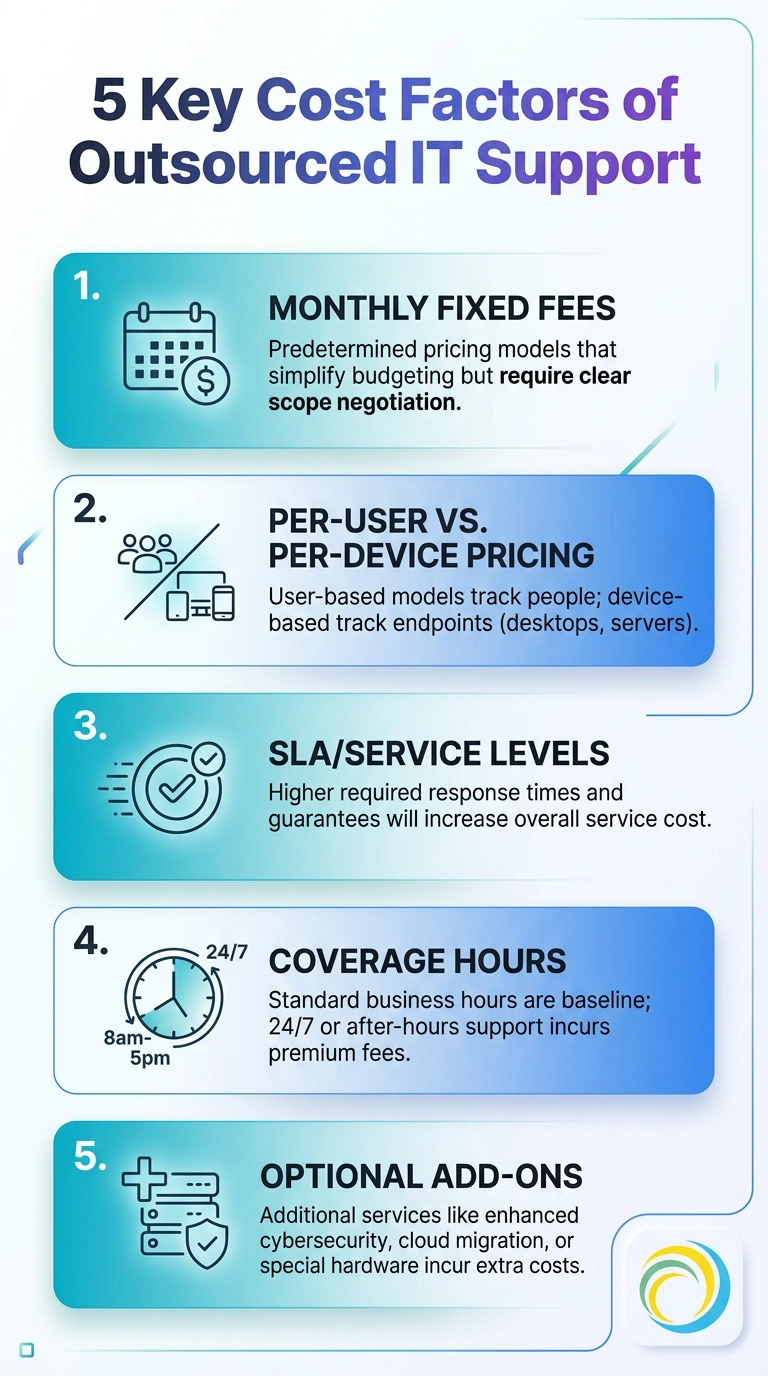
This infographic breaks down the five main cost factors behind outsourced IT support. It helps readers estimate total expenses and compare options.
Outsourced IT Support Cost vs. In-House IT: The Real Numbers
This is the comparison most business owners really want to see. And the honest answer is that for the majority of SMBs, outsourcing is cheaper when you account for everything. However, the risks go well beyond technical inconvenience when you make this calculation incorrectly.
An in-house IT employee in the UK in 2026 carries a total employment cost well above their headline salary. A mid-level IT support engineer at £35,000 per year becomes £45,000 or more once you add employer National Insurance contributions, pension contributions, annual leave cover, sick leave, training costs and the cost of their tools and licences.
And that’s just one person. For a business of 30 to 50 staff, one IT generalist is rarely enough to provide the depth of expertise required across networking, security, cloud, compliance and day-to-day helpdesk. You’d realistically need two, pushing annual in-house IT cost to £90,000 or more before you’ve spent a penny on actual infrastructure.

By contrast, a managed outsourced IT support package covering 30 users with proactive monitoring, helpdesk and basic security might cost £2,500 to £4,000 per month, equating to £30,000 to £48,000 annually. That’s a saving of between 30% and 50% versus comparable in-house provision and you get access to a whole team of specialists rather than one generalist.
Our remote IT support service consistently delivers over 30% savings compared to maintaining an internal team of equivalent capability and that figure only improves as your headcount grows and the per-user rate decreases.
What’s Typically Included in an Outsourced IT Support Package?
Working with an IT provider should be straightforward, transparent and reassuring from the very start. Part of that transparency is knowing exactly what you’re getting for your monthly fee before you sign a contract.
A well-structured outsourced IT support package in 2026 should cover:
- Helpdesk access: Phone, email and remote access support during agreed hours, with defined response time SLAs
- Proactive monitoring: 24/7 device health monitoring to catch problems before they cause downtime
- Patch management: Automated security patches and software updates applied on schedule
- Antivirus and endpoint protection: Managed antivirus aligned with current threat intelligence
- Asset management: An up-to-date register of all managed hardware and software
- Regular reporting: Monthly or quarterly reports covering system health, ticket volumes and resolution times
- Vendor liaison: Your provider handles conversations with Microsoft, broadband providers and hardware suppliers on your behalf

Premium packages often add layers on top of this foundation: a dedicated security operations centre, compliance support, virtual CTO advisory, Microsoft 365 management and structured change management for infrastructure projects.
We simplify the process by offering honest advice, clear communication and step-by-step guidance, so you always know what to expect and more importantly, so you always know what you’re paying for.
The Hidden Costs in Outsourced IT Support Pricing
This is the section that saves you money. Most buyers focus on the monthly per-user rate and treat everything else as a footnote. That is exactly how unexpected bills happen.
Here are the costs that regularly catch businesses off guard when outsourcing IT support:
Setup and onboarding fees. Many providers charge a one-time setup fee to audit your environment, configure monitoring tools and onboard your team. These fees can range from a few hundred pounds to several thousand. Always ask for this figure upfront and get it in writing before signing.
Out-of-scope charges. Your contract defines what’s included. Anything outside that scope, such as a major server migration, new user onboarding beyond your contracted count or project work, will typically attract additional charges at an hourly or day rate. Know your provider’s out-of-scope rate before you need it.
Hardware and software costs. Most outsourced IT support contracts cover the management of your hardware, not the hardware itself. Replacement devices, new licences and specialist software are your cost unless explicitly stated otherwise.
On-site visit charges. If remote resolution isn’t possible, on-site visits may be billed additionally. Check whether your contract includes a fixed number of on-site hours and what the excess rate is.
Escalation and specialist fees. Some providers charge extra for escalated issues that require senior engineers or third-party specialists. If your environment includes legacy systems, niche software or complex infrastructure, this is a real cost to quantify upfront.
Contract exit costs. Long-term contracts with steep exit penalties can make the total cost of outsourced IT support significantly higher if your business circumstances change. Always understand your exit terms before you commit.
SLA Performance: Why Outsourced IT Support Cost Has to Be About Value, Not Just Price
Price matters. But so does what you actually get for it. Outsourced IT support cost is only meaningful when weighed against measurable outcomes and the most important of those is SLA compliance.
If your provider commits to a 4-hour response time but consistently takes 24 hours to resolve P1 issues, every minute of that delay has a cost. Staff sat idle waiting for a critical system to come back online represents real money leaving your business, often far exceeding whatever you thought you were saving on the monthly IT bill.
Enterprise-grade managed IT providers in 2026 often commit to P1 (critical incident) response times of 15 to 30 minutes. If a potential provider can’t clearly articulate their response commitments or hedges on what “response” actually means (acknowledgement vs. active investigation vs. resolution), treat that as a red flag.
That SLA compliance data reinforces a point we make consistently: outsourced IT support cost isn’t just about the monthly invoice. It’s about whether the service actually keeps your systems running at their best and whether you’re protected before problems happen, not scrambling to fix them after.
Best For: Which Businesses Get the Most from Outsourced IT Support
Not every business gets the same return from outsourcing IT. Here is an honest breakdown of which scenarios justify the outsourced IT support cost most clearly.
Best for SMBs without a dedicated IT team. If your business relies on one tech-savvy employee (or worse, someone who “sort of knows computers”) to keep everything running, the risk exposure is enormous. Outsourcing gives you a whole team of certified specialists for a fraction of the cost of even one full-time hire. This is the scenario where the value case is clearest.
Best for businesses in regulated industries. Finance, legal, healthcare, insurance and education all operate under data protection and compliance frameworks (UK GDPR, FCA guidelines, etc.) that require demonstrable IT governance. Outsourced providers with compliance capability remove an enormous burden from your leadership team.
Best for businesses going through growth or change. Scaling headcount, moving offices, migrating to cloud or integrating new systems all create IT complexity that can overwhelm small internal teams. Outsourced IT support scales with you without the hiring lag.
Best for businesses that have experienced a cyber incident. If you’ve been hit by ransomware, phishing or a data breach, the residual risk to your systems is significant. An outsourced provider with security operations capability can harden your environment and provide the ongoing monitoring your business now clearly needs.
Less ideal for: Large enterprises with well-resourced internal IT departments may find that selective outsourcing (specific functions like security operations or cloud management) delivers better value than fully outsourced support. For businesses with highly bespoke or legacy infrastructure, you may also find that the specialist knowledge required increases cost significantly.
How to Evaluate Outsourced IT Support Cost Properly: A 5-Step Approach
Whether you are just starting to explore your options or you already have proposals on the table, a clear, structured approach will save you time, money and a great deal of stress. Here is the process we recommend.
- Audit your current IT spend. Before comparing outsourced IT support cost against anything, document what you currently spend. Include salaries, software licences, hardware replacement, training and the hidden cost of downtime.
- Define your requirements clearly. How many users? How many devices? What hours do you need coverage? Do you have regulatory requirements? The more specific you are, the more accurate and comparable the proposals you receive will be.
- Ask for fully-loaded pricing. Request that every potential provider gives you a complete cost breakdown including setup fees, out-of-scope rates, on-site charges and contract exit terms. Any provider who resists this level of transparency is worth questioning.
- Test SLA commitments. Ask for case studies, client references and average resolution time data. SLA commitments on paper are only as valuable as the provider’s actual track record of meeting them.
- Compare total 3-year cost of ownership. Monthly rates look attractive in isolation. Build a 36-month model that includes expected growth in user numbers, typical out-of-scope work and setup fees. The provider with the lowest headline rate is not always the most cost-effective over the contract term.
What ITERTECH Offers and Why It Matters for Your Budget
At ITERTECH, we take the stress out of IT for small and medium-sized businesses across London and Surrey. We pride ourselves on being the reliable, behind-the-scenes IT heroes our clients count on, delivering proactive solutions, fast response times and jargon-free support.
Our approach to outsourced IT support cost is built around predictability and transparency. We don’t believe in “best-in-class” without the specifics to back it up. When we quote a monthly fee, it reflects a clear scope of services, defined SLAs and honest out-of-scope terms, so you know what you’re getting before you sign anything.
Our security philosophy reflects the same pragmatism. In an ideal world with an unlimited budget, we would have the best tech, but this is not an ideal world, so implementation and intelligent application of security technologies and processes should be used to mitigate current and emerging threats in the context of your business. That means your outsourced IT support cost is focused on what actually protects and enables you, not on technology for technology’s sake.
By partnering with a trusted provider like ITERTECH, businesses can tap into a wealth of IT expertise, ensure their systems are always running at their best and focus on what they do best, which is growing their business. You can explore our full outsourced IT support offering to see how we structure pricing and what’s included as standard.
Conclusion
Outsourced IT support cost in 2026 sits broadly between £60 and £150 per user per month for UK SMBs, with total monthly bills ranging from around £500 for micro businesses up to £18,000 or more for larger organisations. But the number on the invoice is only part of the story.
The real value of outsourced IT support is measured in predictable costs, fewer disruptions, stronger security and access to a depth of expertise that simply isn’t financially viable to replicate in-house. For most SMBs, the decision to outsource IT support isn’t just a cost decision. It’s a decision about peace of mind, resilience and future-proofing your business against the threats and challenges that are only growing in 2026.
The key is choosing a provider that is transparent about pricing from day one, commits to measurable SLAs and understands your business deeply enough to give you proactive advice, not just reactive fixes. That is exactly the standard we hold ourselves to at ITERTECH and it’s the standard you should expect from any provider you seriously consider.
Frequently Asked Questions
How much does outsourced IT support cost per user per month in the UK in 2026?
In 2026, UK businesses typically pay between £30 and £150 per user per month for outsourced IT support on a managed services contract. The exact outsourced IT support cost depends on service scope, coverage hours, security requirements and the size of your organisation.
Is outsourced IT support cheaper than hiring an in-house IT person?
For most SMBs, yes. Once you factor in salary, employer National Insurance, pension, training and leave cover, a single in-house IT employee can cost £45,000 or more per year. A comparable managed outsourced IT support package for a business of 20 to 30 users typically costs significantly less, while providing broader expertise and 24/7 monitoring that a single employee cannot match.
What hidden costs should I look out for when outsourcing IT support?
The most common hidden drivers of outsourced IT support cost include setup and onboarding fees (which can run into thousands of pounds), out-of-scope project charges, on-site visit fees, hardware and software costs and contract exit penalties. Always ask for a fully itemised breakdown before committing.
What is the best pricing model for outsourced IT support for a small business?
Per-user per-month pricing on a managed services contract is generally the best model for small businesses, because it gives you predictable monthly outsourced IT support costs and includes proactive monitoring rather than just reactive fixes. Break-fix and per-ticket models tend to be less cost-effective over a full year for businesses with regular IT activity.
Is outsourced IT support worth it for a business with fewer than 10 employees?
Yes, in most cases. Even with a small headcount, the cost of IT downtime, a cyber incident or a failed system can far exceed a modest monthly outsourced IT support cost. Micro businesses often benefit the most from the peace of mind and proactive protection that a managed service provides, without the overhead of any internal IT resource.
How do I compare outsourced IT support quotes effectively?
Ask every provider for a fully-loaded cost breakdown including setup fees, out-of-scope rates, SLA commitments with historical performance data and exit terms. Build a 36-month total cost model for each proposal rather than comparing headline monthly rates, as the true outsourced IT support cost often looks very different over the contract term.
What should be included as standard in an outsourced IT support package in 2026?
A strong standard outsourced IT support package in 2026 should include helpdesk access with defined SLAs, proactive 24/7 monitoring, patch management, managed antivirus, asset management and regular performance reporting. Security operations, disaster recovery planning and cloud management are typically premium additions that are worth costing in if your business needs them.