
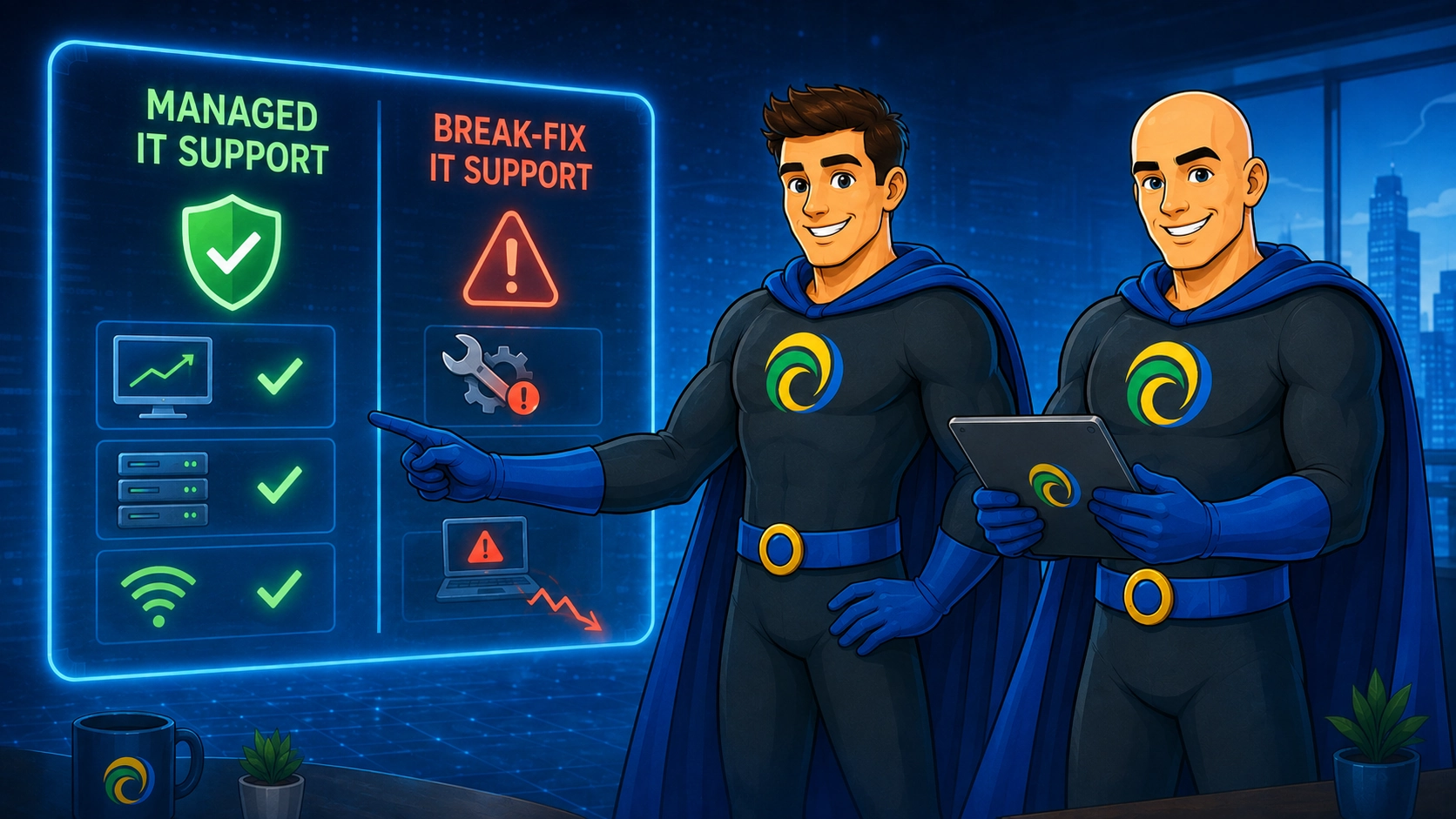
When it comes to managed vs break fix IT support, the choice you make has a direct and measurable impact on your business operations. Small businesses lose an average of £137 to £427 per minute during IT outages, which means even a two-hour failure can cost more than an entire month of managed service fees. Understanding the difference between these two approaches and knowing which is the right fit for your organisation, is one of the most important technology decisions you can make right now.
Key Takeaways
- Managed IT services deliver proactive, ongoing support through a fixed monthly fee, covering monitoring, maintenance, security and helpdesk access.
- Break fix support is reactive, meaning you only call for help when something has already gone wrong and you pay per incident.
- Predictable costs favour managed services; unpredictable or infrequent IT needs can make break fix appear cheaper in the short term.
- Downtime risk is significantly higher under break fix, since problems are addressed after they occur rather than prevented beforehand.
- Compliance and cybersecurity requirements almost always align better with managed IT, where monitoring and patching are continuous rather than occasional.
- SMBs with growth ambitions typically outgrow break fix quickly; outsourced IT support through a managed model scales alongside your business without the overhead of an in-house team.
- The verdict for most businesses in 2026: managed IT support delivers better reliability, lower long-term cost and stronger security posture for the majority of small and medium-sized organisations.
What Is Managed vs Break Fix IT Support?
Before making any decision, it’s worth being clear about what each model actually means in practice, because the two approaches are fundamentally different in philosophy, not just price.
Break fix support is the older, traditional model. Something breaks, you call an IT technician, they fix it and you pay for that time and any parts involved. There’s no ongoing relationship, no monitoring and no proactive intervention. The relationship is entirely transactional.
Managed IT services work on a completely different basis. You pay a fixed monthly fee and your IT provider takes responsibility for the health, performance and security of your systems continuously. Issues are identified and resolved, in many cases, before you’re even aware of them. Think of it less as hiring a plumber and more as having a facilities management team permanently on call.
The managed vs break fix debate is, at its core, a question of whether you want to be reactive or proactive with your technology.
The Core Differences Between Managed and Break Fix IT Models
Setting the two models side by side makes the structural differences very clear.
| Factor | Managed IT Services | Break Fix Support |
|---|---|---|
| Approach | Proactive and preventative | Reactive and incident-driven |
| Cost structure | Fixed monthly fee | Pay per incident |
| Monitoring | 24/7 continuous RMM monitoring | No ongoing monitoring |
| Security | Included, layered, continuous | Addressed only when breached |
| Business continuity | Core part of the service | Not a built-in consideration |
| Relationship type | Long-term partnership | Transactional, ad-hoc |
| Best for | Growing SMBs, compliance-heavy sectors | Very small operations, minimal IT needs |
Managed vs Break Fix: Best for Predictable Costs and Business Stability
One of the most common arguments in favour of break fix is cost. “We don’t have many IT issues, so why pay every month?” It’s a reasonable question, but it misses a critical point: the cost of break fix isn’t just the technician’s hourly rate.
When a server goes down, a critical application crashes or a cyberattack disrupts your operations, you’re not just paying for the fix. You’re absorbing the cost of downtime, lost productivity, missed customer interactions and potential data loss. These hidden costs are rarely factored into the perceived “savings” of a break fix arrangement.
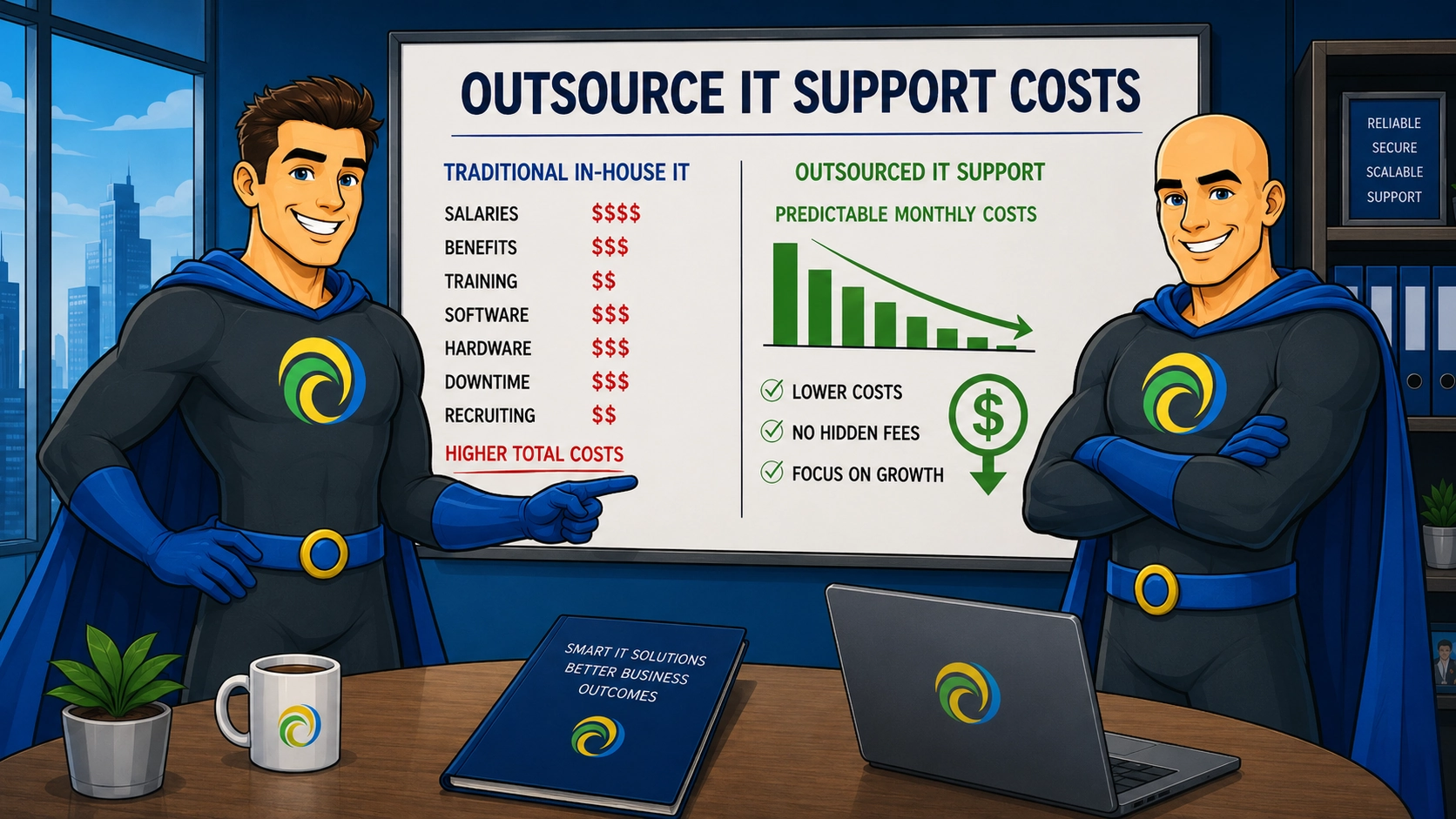
Managed IT services, by contrast, give your finance team something to work with: a fixed, predictable monthly cost that covers monitoring, patching, helpdesk, security management and strategic planning. That predictability is enormously valuable for budgeting, particularly for small and medium-sized businesses operating on tight margins.
At ITERTECH, we take the stress out of IT for small and medium-sized businesses across London and Surrey. A core part of that means removing the financial unpredictability that comes with reactive, break fix thinking.

That 15.3 minutes per employee per day adds up fast. Across a team of 20 people, that’s five hours of lost productive time daily, roughly three full working weeks every year, simply because IT systems aren’t being properly maintained and optimised. Managed IT services are specifically designed to recover that lost time through continuous system optimisation and proactive resolution.
Best for Growing SMBs: Why Managed IT Outperforms Break Fix at Scale
Here’s a pattern we see regularly. A business starts small, perhaps five or ten people, with minimal IT infrastructure. Break fix works fine. Then they grow. They add staff, migrate to cloud platforms, handle more customer data and suddenly their technology is the backbone of everything they do.
At that point, break fix becomes genuinely dangerous. There’s no monitoring. No one is watching for early warning signs of hardware failure, suspicious network activity or systems drifting out of compliance. Problems only surface once they’re already critical.
Managed IT scales with your business in a way that break fix simply cannot. As your dedicated IT partner, we handle everything from IT support and cloud services to cybersecurity, network management and much more, so you can focus on running your business, not fighting tech issues.

For any SMB with growth ambitions, professional IT services built on a managed model are the only rational choice as complexity increases.
Managed vs Break Fix for Cybersecurity: There Is No Comparison
If there is one area where the managed vs break fix debate has a truly clear answer in 2026, it’s cybersecurity. Break fix has no meaningful answer to the modern threat landscape.
Cyberattacks don’t wait for you to call a technician. Ransomware deploys in minutes. Phishing campaigns run 24 hours a day. Vulnerabilities are exploited the moment patches fall behind. A break fix provider isn’t watching your environment, isn’t applying updates proactively and isn’t running threat detection tools continuously.
In an ideal world with an unlimited budget, you’d have the best tech across the board. But as we’ve always believed, intelligent application of security technologies and processes should be used to mitigate current and emerging threats in the context of the business. That risk-based perspective is built into managed IT from day one and it simply doesn’t exist in the break fix model.
Managed services typically include endpoint security, MFA enforcement, patch management and often access to a Security Operations Centre (SOC) or MDR capability. These aren’t extras; they’re the baseline of what responsible IT management looks like in 2026.
You can read more about how endpoint security solutions form a core part of a properly managed IT environment.
When Break Fix IT Support Might Still Make Sense
To give a balanced picture: there are scenarios where break fix remains a practical option. It’s important to be honest about that rather than dismiss it entirely.
- Sole traders with minimal IT dependency who use only a single device with cloud-based applications may find a managed model difficult to justify.
- Businesses with an internal IT team sometimes use break fix providers for overflow support or specialist tasks outside their team’s skillset.
- Very temporary or project-based operations that won’t exist beyond a defined window may not need an ongoing managed relationship.
- Supplementary hardware repairs such as physical device replacements are sometimes handled on a break fix basis even within managed agreements.
Outside of these specific situations, however, the operational, financial and security risks of relying on break fix as your primary IT model increase significantly as your business grows.
The Hidden Costs of Break Fix: Managed vs Break Fix Beyond the Invoice
Break fix providers charge by the hour or by the job. That invoice is visible and, initially, it might seem low. But there are costs that never appear on any invoice from a break fix provider.
Consider a scenario we’ve seen play out for businesses: a server failure hits on a Monday morning. The break fix provider is called. They attend within hours (if you’re lucky) or the next day (if you’re not). During that window, your team cannot access shared files, your VoIP phones are down and you cannot process customer orders. Every one of those minutes carries a real financial cost that has nothing to do with the technician’s labour rate.
Managed IT services include response time agreements (SLAs), proactive monitoring that often catches hardware degradation before failure and business continuity planning that ensures your operations can keep running even when something goes wrong. That’s a fundamentally different level of protection.
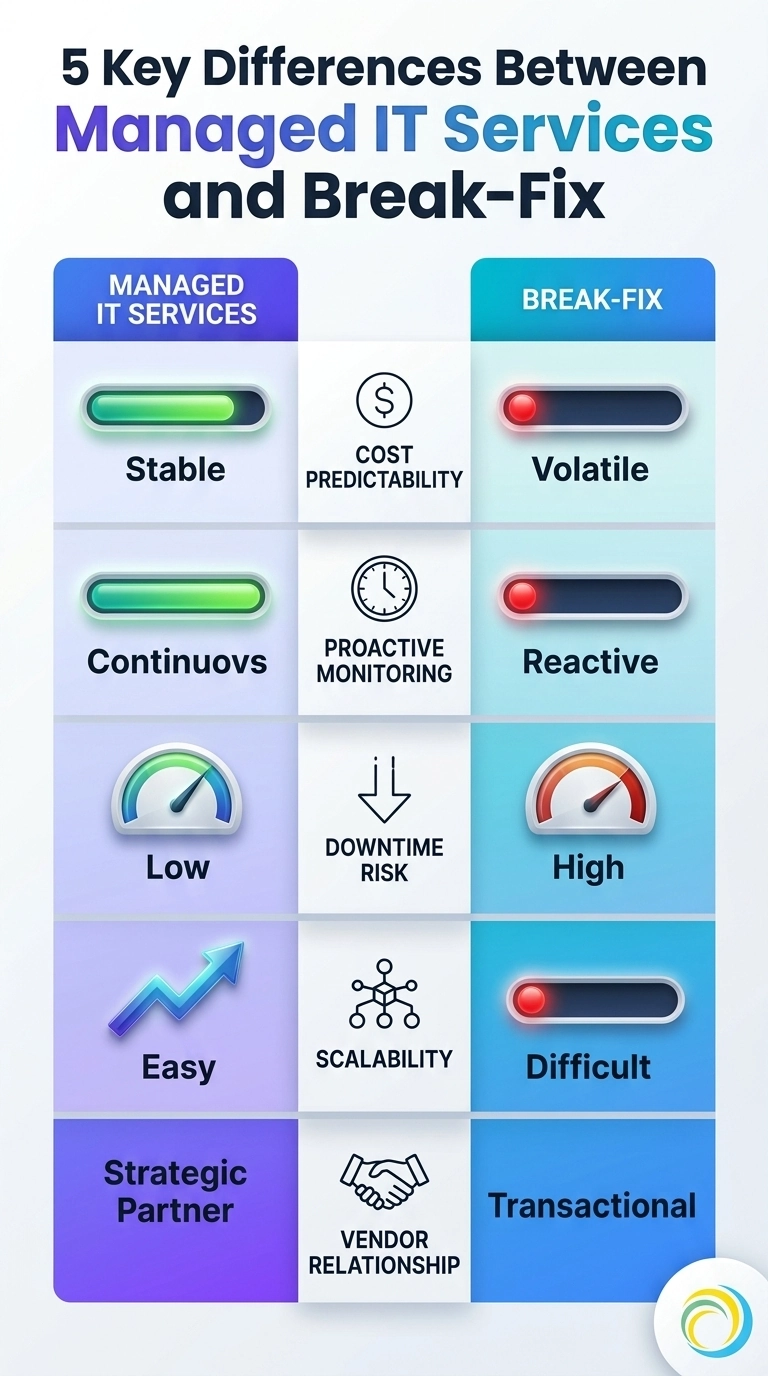
A visual comparison of managed IT services and break-fix, highlighting five key differences in approach, cost and reliability. Use this infographic to decide which model fits your business.
Managed vs Break Fix: What to Look for When Choosing a Managed IT Provider
If the managed model is the right fit for your business, the next question is what to look for in a provider. Not all managed service providers operate the same way and the quality of service varies considerably.
We pride ourselves on being the reliable, behind-the-scenes IT heroes our clients count on, delivering proactive solutions, fast response times and jargon-free support. But beyond the brand promise, here’s what actually matters when evaluating any managed IT provider:
- Defined SLAs with clear response and resolution time commitments, not vague assurances.
- Proactive monitoring using RMM tooling, not just reactive ticketing.
- Cyber security as standard, including patch management, endpoint protection and ideally MDR or SOC-level monitoring.
- Clear scope of service so you know exactly what’s included and what falls outside the agreement.
- Strategic IT alignment, meaning your provider understands your business goals and helps your technology support them, not just keeps the lights on.
- Transparent communication, with regular reporting and a single point of contact you can actually reach.
It’s technology you can trust and a partnership you’ll love. That should be the benchmark, not just technical competence.
With costs like those, a single significant outage under a break fix arrangement can wipe out months of perceived savings. It’s a risk that most businesses simply cannot afford to take.
Managed vs Break Fix: Making the Right Decision for 2026
The managed vs break fix debate isn’t purely theoretical. In 2026, with cyberthreats more sophisticated than ever, compliance requirements tightening across most industries and SMBs increasingly reliant on cloud-based infrastructure to operate, the stakes around IT reliability are higher than they’ve ever been.
Break fix had its place in an era when IT was simpler and business-critical systems could tolerate a few hours of downtime without major consequence. That era is over for most organisations.
Managed IT services provide the proactive solutions, ensuring business continuity and layered cybersecurity that modern businesses actually need, delivered through a partnership model rather than a transactional one. For most SMBs across the UK, the question isn’t really “managed or break fix?” It’s “which managed IT provider is the right one for us?”
If you’re currently operating on a break fix basis and recognise the risks outlined here, now is the time to explore what a managed model could look like for your organisation. Our remote IT support services offer a flexible and accessible starting point and our full IT support offering covers businesses across Surrey, Hampshire and Berkshire with fast, reliable, proactive cover.
When you lay the managed vs break fix models side by side, the operational, financial and security arguments consistently favour managed IT for any business that depends on reliable technology to serve its customers and grow. Break fix may look cheaper on paper, but the hidden costs of downtime, the absence of cybersecurity monitoring and the lack of strategic alignment make it a high-risk approach for most SMBs in 2026.
We handle everything from IT support and cloud services to cybersecurity and network management, so you can focus on running your business, not fighting tech issues. If you’re ready to move beyond reactive IT and into a model that actually supports your business goals, explore our outsourced IT support services and find out what the right partnership looks like for your organisation.
Frequently Asked Questions
What is the main difference between managed IT services and break fix?
Managed IT services provide ongoing, proactive monitoring and support for a fixed monthly fee, covering your systems continuously. Break fix support is purely reactive, meaning a technician is only engaged after something has already failed and you pay per incident. The managed vs break fix distinction comes down to prevention versus reaction.
Is managed IT support worth it for small businesses in 2026?
For most small businesses in 2026, managed IT is significantly more cost-effective once you account for downtime costs, cybersecurity requirements and the productivity impact of unresolved IT issues. With businesses losing £137 to £427 per minute during outages, the fixed monthly cost of managed services typically delivers far better value than the unpredictable expenses of break fix.
How much does managed IT cost compared to break fix?
Managed IT services are priced on a per-user or per-device monthly basis, providing predictable costs that businesses can budget for. Break fix appears cheaper until an incident occurs, at which point emergency call-out rates, extended downtime and data recovery costs can vastly exceed what a managed contract would have cost. The true comparison isn’t monthly fee vs zero, it’s monthly fee vs total annual incident cost.
Can a business switch from break fix to managed IT services?
Yes and it’s a straightforward transition when handled by an experienced managed service provider. The process typically involves an IT audit to understand your current environment, followed by onboarding into monitoring and management tooling. Most businesses see improved system stability within the first 30 to 60 days of switching from break fix to a managed model.
What does a managed IT service typically include that break fix does not?
A managed IT service typically includes 24/7 remote monitoring (RMM), proactive patch management, cybersecurity tooling such as endpoint protection and MFA, helpdesk access with defined SLAs, strategic IT planning and business continuity support. None of these are standard features of break fix arrangements, which cover only the specific fault reported at the time of each callout.
Is break fix IT support still a viable option in 2026?
Break fix remains viable in very limited circumstances, primarily for sole traders with minimal IT infrastructure or businesses supplementing an existing internal IT team. For any organisation that relies on IT to serve customers, manage data or operate business-critical systems, break fix creates unacceptable levels of downtime risk and security exposure in 2026’s threat environment.
What should I ask a managed IT provider before signing a contract?
The key questions to ask cover response time guarantees (SLAs), what’s included versus out of scope, how cybersecurity is handled, what reporting you’ll receive and whether strategic IT planning is part of the service. You should also ask for references or case studies that demonstrate how the provider has managed real incidents and confirm that jargon-free communication is a standard part of their client relationship.