

Knowing how to optimise cloud computing costs for remote workforces has never been more urgent: cloud waste rose to 29% in 2025, the first increase in five years, largely driven by unmanaged AI workloads that remote teams are quietly spinning up across their organisations. For SMEs across Surrey, Berkshire, Hampshire and London, that waste is not an abstract statistic — it is real money leaving your business every single month.
Key Takeaways
- Cloud waste is rising: Unmanaged AI and self-service tools used by remote workers are the primary driver. Governance and oversight are essential in 2026.
- Start with a usage audit: You cannot manage what you cannot see. Mapping your actual cloud consumption is the first step toward meaningful cost reduction.
- Right-size your licences: Many remote teams carry unused seats and over-provisioned services. Reviewing Microsoft 365 licences alone can generate immediate savings.
- Use FinOps principles: Dedicated cost ownership — even informally — leads to faster decisions and less waste across distributed teams.
- Platform choice matters: Microsoft Azure and Google Cloud Platform both offer native cost management tools. Use them proactively, not reactively.
- Remote IT support adds value: An experienced managed service provider (MSP) aligned to FinOps outcomes is one of the most cost-effective investments a growing SME can make.
- Scalability is a cost lever: The ability to scale up and down in real time is cloud’s greatest financial advantage — but only if it is actively managed.
Why Cloud Cost Optimisation Matters More Than Ever for Remote Workforces
Remote working has fundamentally changed the way businesses consume cloud resources. Where once IT provisioned services centrally, today individual employees, departments and project teams are spinning up tools, subscriptions and virtual environments on their own.

The result is what we in the industry call Shadow AI and shadow IT: untracked usage that accumulates silently until a billing shock arrives. We treat this as a risk management issue, not a blame exercise — but the cost consequences are real and entirely avoidable.
For SMEs in particular, the lack of a dedicated IT function means that cloud costs often go unreviewed for months at a time. That is where proactive guidance makes the difference between a cloud investment that delivers business continuity and one that quietly drains your budget.
How to Optimise Cloud Computing Costs: Begin with a Cloud Usage Audit
Before you can reduce cloud spend, you need to understand exactly what your remote workforce is consuming and why. A cloud usage audit maps every active service, licence, virtual machine and storage bucket across your environment.
This is rarely a one-off exercise. We recommend scheduling a quarterly review as a minimum, particularly as remote teams grow and tool adoption shifts throughout the year.
The audit should answer four core questions:
- What services are active? — Including any provisioned by individual users without central approval.
- What is actively used versus idle? — Idle resources are pure waste. Shut them down or right-size them immediately.
- Who owns each cost centre? — Without clear ownership, no one acts on overspend.
- What is the trajectory? — Is spend growing faster than headcount or revenue? That is a signal your governance model is not keeping pace.
At ITERTECH, we deliver stress-free IT solutions designed for SMEs and a cloud audit is one of the first things we carry out when working with a new client. It provides the roadmap everything else is built on.

Right-Sizing Licences: The Fastest Way to Optimise Cloud Computing Costs
Licence sprawl is one of the most common and most overlooked sources of cloud waste in remote-first businesses. When employees leave, change roles or simply stop using a tool, their licences rarely get cancelled automatically.
Reviewing your active licence assignments across platforms like Microsoft 365 can surface immediate savings. We frequently find businesses paying for E3 or E5 licences for users who only need basic email and file access.
The right approach is to match licence tier to actual usage. Not every remote worker needs the same level of access and right-sizing your assignments to reflect real-world requirements is one of the highest-return optimisation actions available to you.
Beyond individual licences, look at whether your business is duplicating functionality across platforms. If your team uses Microsoft Teams for meetings but also pays for a separate video conferencing tool, that is an unnecessary cost that your cloud strategy should eliminate.
How to Optimise Cloud Computing Costs Through Smart Platform Strategy
The platform decisions you make have a direct and lasting impact on your cloud bill. Not all cloud environments are priced the same and the right architecture for your remote workforce depends on how your people actually work.
Microsoft Azure enables organisations to scale resources instantly, supporting growth without costly delays while maintaining full operational efficiency. For businesses already invested in the Microsoft ecosystem, Azure’s native integration with Microsoft 365 removes the duplication that drives unnecessary spend.
Google Cloud Platform offers strong per-second billing and sustained-use discounts that benefit remote workforces with variable, unpredictable usage patterns. Our consultancy helps you design connected solutions that reduce reliance on costly on-premise systems while giving your distributed team reliable, fast access to everything they need.
A key principle we apply is this: cloud infrastructure should scale with your business, not against it. We facilitate the scalability needed to expand your business while keeping needs like flexible working and security at the forefront — and that means provisioning environments that can grow or shrink as demand changes, rather than locking you into fixed capacity you may not always need.
Our cloud services for businesses in Surrey, Berkshire and Hampshire support Microsoft 365, Azure, Google Cloud, hosting and backup as part of a cohesive strategy. Every recommendation we make takes into account risk, usability, compliance and long-term sustainability.
Using FinOps to Optimise Cloud Computing Costs Across Remote Teams
FinOps (Financial Operations) is the practice of bringing financial accountability to cloud spending. It is no longer just for enterprise organisations. 59% of organisations now have a dedicated FinOps team, up from 51% the previous year — and for good reason.
For remote workforces, FinOps is especially valuable because cost responsibility is distributed. Without a clear owner for each cloud cost centre, overspend becomes everyone’s problem and no one’s priority.
You do not need a large team to adopt FinOps principles. Even in a small SME, appointing a single person responsible for monthly cloud cost reviews — with visibility across all departments — creates the accountability needed to drive down waste.
Practical FinOps actions for remote teams include:
- Tagging every cloud resource by department, project or user so spend is attributable.
- Setting budget alerts on all cloud accounts so unexpected spikes trigger an immediate review.
- Reviewing reserved instance commitments annually to ensure your reserved capacity still matches actual usage.
- Using showback reports to make each team aware of the costs they are generating, even without formal chargeback.
- Scheduling non-production environments to shut down outside of working hours — a simple automation that can cut development environment costs by 30-40%.
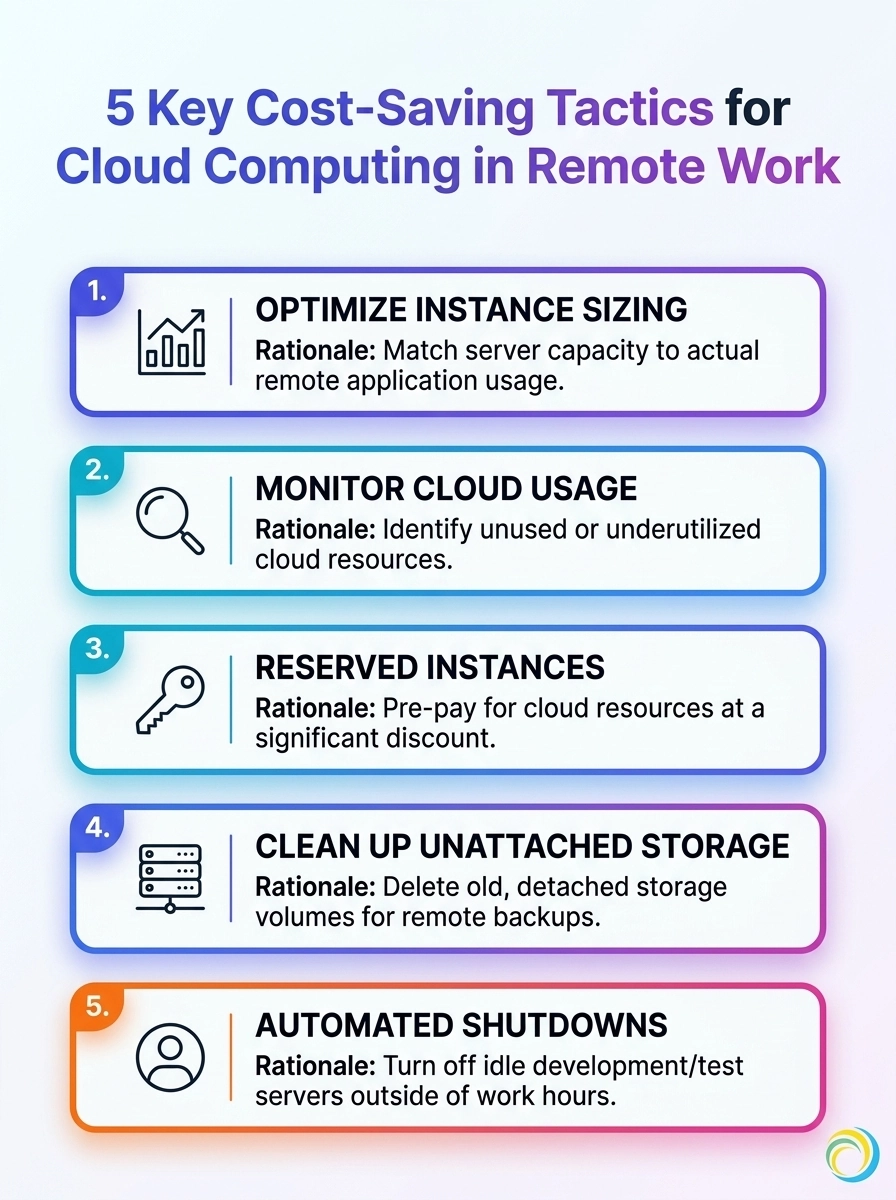
Discover practical strategies to lower cloud computing expenses while supporting a distributed workforce.
Managing AI Workloads: The New Cloud Cost Frontier for Remote Teams
The rise of generative AI has introduced a new and fast-growing category of cloud expenditure. GenAI usage jumped 8 percentage points to 58% in 2026, meaning more than half of organisations now have remote workers actively using AI tools — many of which carry significant compute costs.

The problem is not the tools themselves. It is the speed of adoption outpacing the governance frameworks needed to manage the spend they generate.
We approach this exactly as we approach Shadow AI audits: as a risk management issue, not a blame exercise. The goal is not to restrict your team’s use of AI tools — it is to ensure those tools are provisioned, monitored and governed in a way that keeps costs predictable and compliant.
For remote workforces, this means establishing clear policies around which AI services can be self-provisioned, which require IT approval and how AI workload costs are tracked and attributed. These technologies are no longer confined to theoretical research — they are now driving real-world applications across various industries and the cost implications are real-world too.
How Remote IT Support Helps You Optimise Cloud Computing Costs Long-Term
One of the most effective ways to keep cloud costs under control for a remote workforce is to have expert eyes on your environment on a continuous basis. Not once a year at renewal time. Continuously.
Our remote IT support services connect your business with certified IT experts who monitor, manage and optimise your cloud environment as part of an ongoing relationship. A reliable provider will show how problems move from first contact to resolution — and cost anomalies are problems, just quieter ones.
With over 50 years of cumulative experience across our team, we understand that for SMEs in London, Surrey, Berkshire and Hampshire, the real value of managed IT support is not just technical. It is the peace of mind that comes from knowing your cloud investment is being actively managed by people who understand both the technology and your business goals.
We focus on understanding how your business works and what you are trying to achieve, so technology supports your goals rather than hampering them. That philosophy applies directly to cloud cost management: the right strategy is not always the most technically sophisticated one, it is the one that works reliably for your team and your budget.
Common Cloud Cost Mistakes Remote Teams Make in 2026
Understanding how to optimise cloud computing costs for remote workforces also means knowing what traps to avoid. These are the patterns we see most consistently when working with new clients:
- Over-provisioning from day one: Teams estimate generously when setting up cloud environments and rarely revisit those estimates. Right-size from the outset and adjust as you learn your actual usage.
- Ignoring data egress costs: Moving data out of a cloud environment carries charges that catch many businesses off guard. Design your architecture to minimise unnecessary data transfer.
- No decommissioning process: When a project ends or an employee leaves, their cloud resources rarely get shut down automatically. A formal decommissioning checklist is simple to implement and saves real money.
- Treating cloud as a fixed cost: Cloud is a variable cost by design. Businesses that treat it like a fixed monthly bill lose the core financial advantage that cloud is meant to provide.
- No visibility across platforms: Many remote teams use Azure, Google Cloud and various SaaS tools simultaneously, with no unified view of total spend. Consolidated reporting is not optional — it is foundational.
- Skipping security investment: Under-investing in endpoint security can lead to breaches that generate enormous unplanned cloud costs through incident response, data recovery and compliance remediation.
Building a Cloud Cost Roadmap for Your Remote Workforce
Optimising cloud computing costs is not a one-time project. It is an ongoing discipline that needs to be built into how your business manages technology at every level.
A practical roadmap for SMEs starts with three horizons:
- Immediate (0-30 days): Conduct a usage audit, identify idle or orphaned resources and right-size licences. These actions typically surface quick wins that fund the longer-term work.
- Short-term (1-3 months): Implement tagging, budget alerts and basic FinOps reporting. Establish ownership of each cloud cost centre across your remote team.
- Ongoing (quarterly): Review reserved instance commitments, revisit AI tool governance and align cloud architecture to changes in your workforce or product strategy.
We pride ourselves on only recommending what is appropriate for your business needs, taking into account risk, usability, compliance and long-term sustainability. That means your cloud cost roadmap will look different from the next business’s — because your workforce, your tools and your growth trajectory are different.
For businesses in Surrey, Berkshire and Hampshire, we offer consultancy and managed cloud services that are built around your specific operational context — not a generic framework dropped in from above.
And because we operate with no contract required, you can trust that our recommendations are driven by what is genuinely best for your business, not by lock-in.
Learning how to optimise cloud computing costs for remote workforces in 2026 comes down to one foundational principle: visibility leads to control and control leads to savings.
The businesses that are winning on cloud costs right now are not necessarily the ones with the most sophisticated tools. They are the ones with clear ownership, regular reviews and a trusted technology partner who understands both the technical landscape and the commercial pressures of running a growing business.
Whether you are looking to right-size your Microsoft 365 licences, bring AI workload costs under control or build a proactive cloud governance model for your distributed team, we are here to help. It is technology you can trust and a partnership you will love.
Get in touch with the ITERTECH team to talk through how to optimise cloud computing costs for your remote workforce — with no obligation and no contract required.
Frequently Asked Questions
How do I reduce cloud costs for a remote workforce without impacting productivity?
Start by auditing your actual usage rather than your provisioned capacity. Most remote teams carry 20-40% of unused or over-provisioned resources that can be eliminated or right-sized without any impact on day-to-day work. Implement budget alerts and governance policies so that future spending stays aligned with real need.
What is the best cloud platform for optimising costs for a small remote team?
For small and mid-sized businesses already in the Microsoft ecosystem, Azure combined with Microsoft 365 typically delivers the best cost-to-value ratio because the native integrations eliminate duplication. Google Cloud Platform is worth evaluating if your team has variable usage patterns, as its per-second billing and sustained-use discounts can deliver meaningful savings.
Is cloud cost optimisation worth the effort for SMEs in 2026?
Absolutely. With cloud waste now at 29% of total cloud spend according to Flexera’s data, even a modest optimisation effort typically returns far more than it costs. For SMEs, where every pound matters, the return on a structured cloud cost review can be significant within weeks.
How does Shadow AI affect cloud computing costs for remote workers?
Shadow AI refers to AI tools and services that remote workers adopt and run without central IT oversight or approval. These tools often carry compute costs that are billed directly to the business’s cloud account, generating unexpected spend that is difficult to attribute or control. Governance policies and regular audits are the most effective way to manage this risk.
What is FinOps and do remote teams need it?
FinOps is the practice of creating shared financial accountability for cloud spending across technical and business teams. Remote teams benefit particularly because cost responsibility is distributed: without clear ownership, overspend accumulates without anyone acting on it. Even a lightweight FinOps approach, such as assigning one cost owner per platform and running monthly reviews, can significantly reduce waste.
How often should we review our cloud costs for a remote workforce?
Monthly reviews are the recommended minimum for most SMEs, with a more comprehensive quarterly review covering licence assignments, reserved capacity and platform strategy. As AI adoption and remote headcount change quickly, more frequent monitoring through automated budget alerts is also strongly advisable.
Can an MSP help us optimise cloud computing costs for our remote team?
Yes and this is increasingly common. 48% of organisations now use MSPs for at least some public cloud management. The key is choosing an MSP whose contract is aligned to measurable cost outcomes, not just uptime and who brings proactive governance rather than reactive support.