
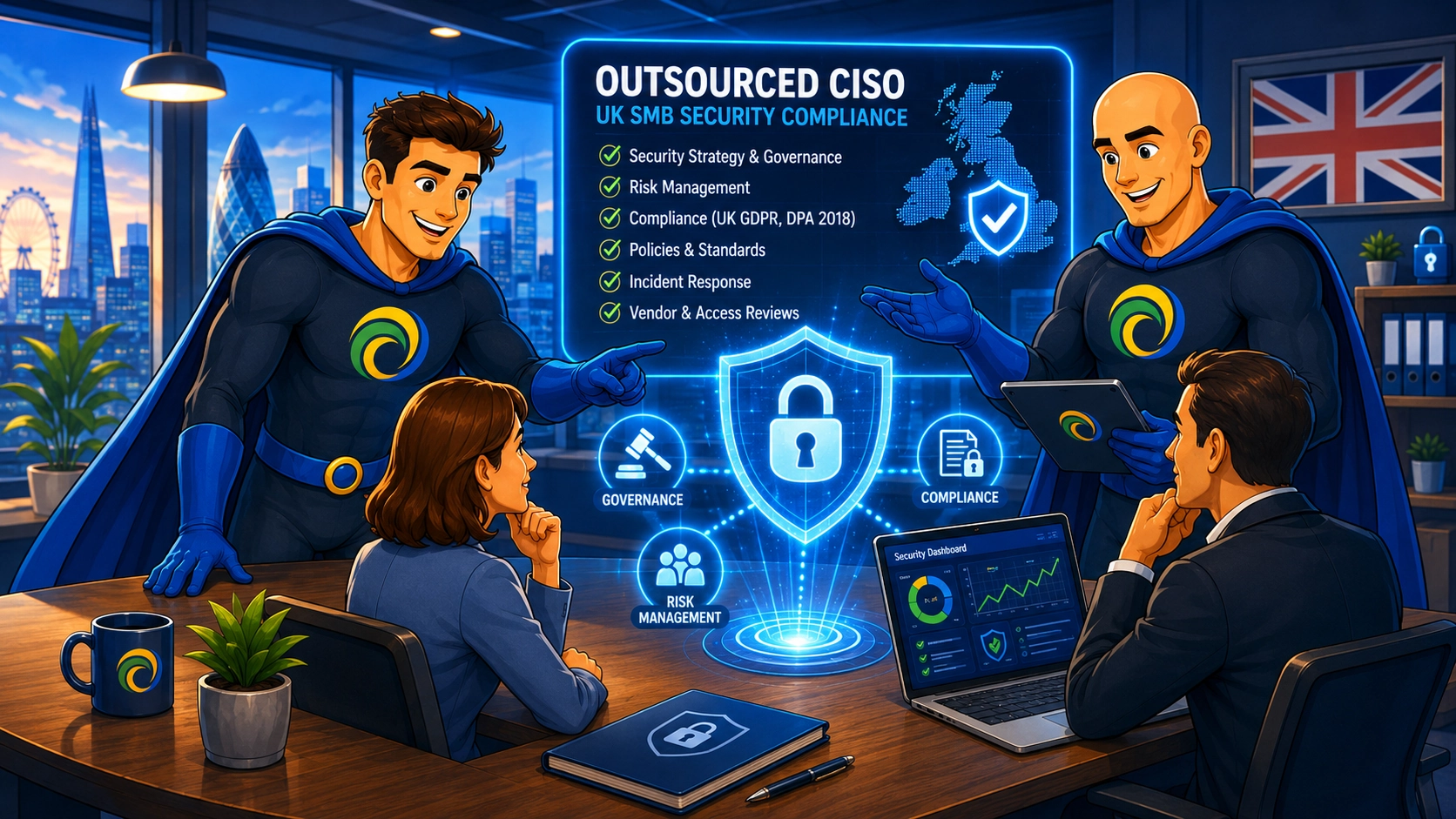
If you’re looking to hire an outsourced CISO for UK SMB security compliance, you’re already ahead of the curve, because 43% of UK businesses reported experiencing a cyber security breach or attack in the last 12 months and the majority of those organisations had no senior security leader in place to manage the response. For small and medium-sized businesses, the cost of hiring a full-time Chief Information Security Officer is simply out of reach, yet the regulatory pressure and threat landscape demand exactly the level of governance a CISO provides.
Key Takeaways
| Question | Answer |
|---|---|
| What is an outsourced CISO for UK SMBs? | An outsourced CISO (also called a virtual CISO or vCISO) provides Chief Information Security Officer-level leadership on a fractional or contract basis, giving SMBs senior security expertise without the cost of a full-time hire. |
| Why do UK SMBs need a CISO for compliance? | UK regulations including UK GDPR, the Network and Information Systems (NIS2) Directive and Cyber Essentials all require documented security governance, risk management and incident response processes that a CISO oversees. |
| How much does an outsourced CISO cost vs a full-time hire? | A full-time CISO in the UK typically commands a salary of £120,000 to £180,000 per year. An outsourced CISO model delivers the same strategic guidance at a fraction of that cost, making it practical and realistic for growing businesses. |
| What does a virtual CISO actually do day-to-day? | A vCISO builds and maintains your security policies, oversees risk assessments, manages compliance frameworks, coordinates incident response and provides board-level reporting on your security posture. |
| Which CISO-as-a-Service provider is best for UK SMBs? | ITERTECH’s virtual CISO services are specifically designed for small and medium-sized UK businesses, combining strategic security leadership with practical, jargon-free support across compliance and risk management. |
| Is an outsourced CISO suitable for businesses without an IT team? | Yes. A well-structured vCISO engagement works alongside your existing IT provider or managed service partner, embedding governance into whatever security stack you already have in place. |
| How quickly can an outsourced CISO improve compliance posture? | Most engagements begin delivering measurable results within the first 30 to 90 days, covering policy documentation, risk registers and compliance gap assessments before moving into ongoing governance cycles. |
Why UK SMBs Now Need to Hire an Outsourced CISO for Security Compliance

The compliance landscape for UK businesses has changed significantly. Between UK GDPR obligations, the expanding scope of the Cyber Essentials scheme and the incoming NIS2 framework, the pressure on SMBs to demonstrate formal security governance has never been greater.
The problem is straightforward: most SMBs simply don’t have a senior security professional on the payroll. The result is a gap between what regulators expect and what the business can actually evidence.
Hiring an outsourced CISO for UK SMB security compliance fills that gap directly. You get the strategic direction, policy oversight and regulatory alignment that your organisation needs, without the overhead of a permanent C-suite salary.
This model, often called CISO-as-a-Service (CISOaaS), is growing rapidly across the UK because it delivers practical results: documented frameworks, risk registers, incident response playbooks and the kind of board-level reporting that demonstrates to auditors and regulators that your organisation takes security seriously.
Understanding What an Outsourced CISO for UK SMB Security Compliance Actually Delivers
Before choosing a provider, it helps to be clear on what an outsourced CISO engagement looks like in practice. This is not a consultancy report that sits in a drawer. A well-run vCISO service is an ongoing function, integrated into how your business manages risk every day.
The core responsibilities typically include:
- Security policy development and maintenance: Building the documented frameworks that regulators and auditors need to see, covering areas like acceptable use, data handling, access control and incident response.
- Risk assessments and management: Identifying, scoring and tracking risks across your systems, suppliers and processes, so you have a live risk register rather than a one-off snapshot.
- Compliance programme oversight: Mapping your controls to the relevant frameworks, whether that is Cyber Essentials, ISO 27001, UK GDPR or sector-specific requirements.
- Incident response planning: Designing and testing your response procedures, so that if something does go wrong, your team knows exactly what to do and who to notify.
- Supplier and third-party governance: Reviewing the security posture of the vendors and partners you rely on, because your compliance obligations extend to how they handle your data.
- Board and executive reporting: Translating technical security metrics into business language, so your leadership team can make informed decisions without needing a security background.

Best for Hire an Outsourced CISO for UK SMB Security Compliance: ITERTECH vCISO Services
ITERTECH’s virtual CISO services are built specifically for UK small and medium-sized businesses that need senior security leadership without a full-time salary commitment. Founded by industry experts with over 50 years of combined experience, ITERTECH is designed to adapt to the evolving needs of businesses and that philosophy sits at the heart of every vCISO engagement.
The service covers governance, risk and compliance as a continuous function rather than a one-off project. That means you get strategic guidance, policy oversight and regulatory alignment that keeps pace with how your business and the threat landscape both change over time.
What makes this model practical for SMBs is the combination of depth and accessibility. The ITERTECH team takes the stress out of security compliance by handling the complexity of frameworks, documentation and regulatory mapping, so your leadership team can focus on running the business rather than decoding compliance requirements.
The engagement integrates naturally with the wider cyber security services ITERTECH provides, including Security Operations Centre monitoring, endpoint protection, identity and access management and network security. This means your vCISO isn’t working in isolation: they’re directing a joined-up security function, not just producing documents.
How an Outsourced CISO Supports UK SMB Security Compliance Frameworks
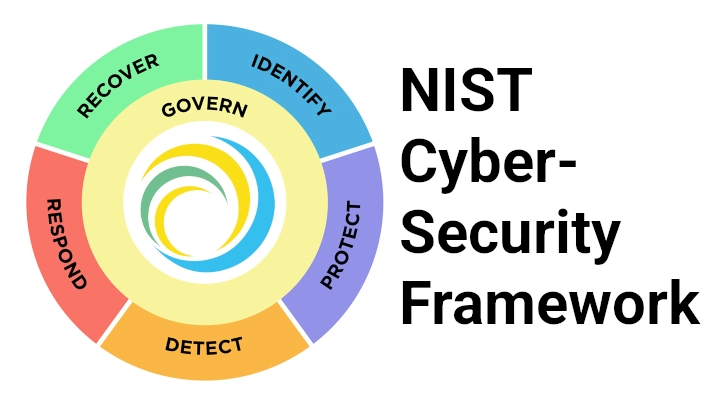
When UK regulators and auditors examine your compliance posture, they want to see evidence: documented policies, risk registers, access controls, training records and incident logs. An outsourced CISO for UK SMB security compliance builds and maintains exactly this evidence base.
The frameworks most relevant to UK SMBs in 2026 include:
- UK GDPR and Data Protection Act 2018: Requires documented data processing activities, lawful basis documentation, privacy notices and data breach notification procedures.
- Cyber Essentials and Cyber Essentials Plus: The UK government-backed certification that covers five core controls: boundary firewalls, secure configuration, access control, malware protection and patch management.
- ISO 27001: The international standard for information security management systems, increasingly required by enterprise procurement teams and financial sector clients.
- NIS2 Directive: The expanded Network and Information Systems regulations that extend compliance obligations to a broader range of sectors and supply chains.
A vCISO cuts through the complexity of these overlapping frameworks by building a single, coherent security programme that satisfies the requirements of multiple standards simultaneously. Rather than treating each audit as a separate exercise, your CISO maps your controls once and maintains them continuously, so that when an assessor arrives, the evidence is already there.
It’s also worth noting that staff security training is a compliance requirement under most of these frameworks and a well-structured vCISO engagement coordinates that training programme as part of the wider governance cycle, with measurable outcomes and reporting to demonstrate effectiveness to auditors.
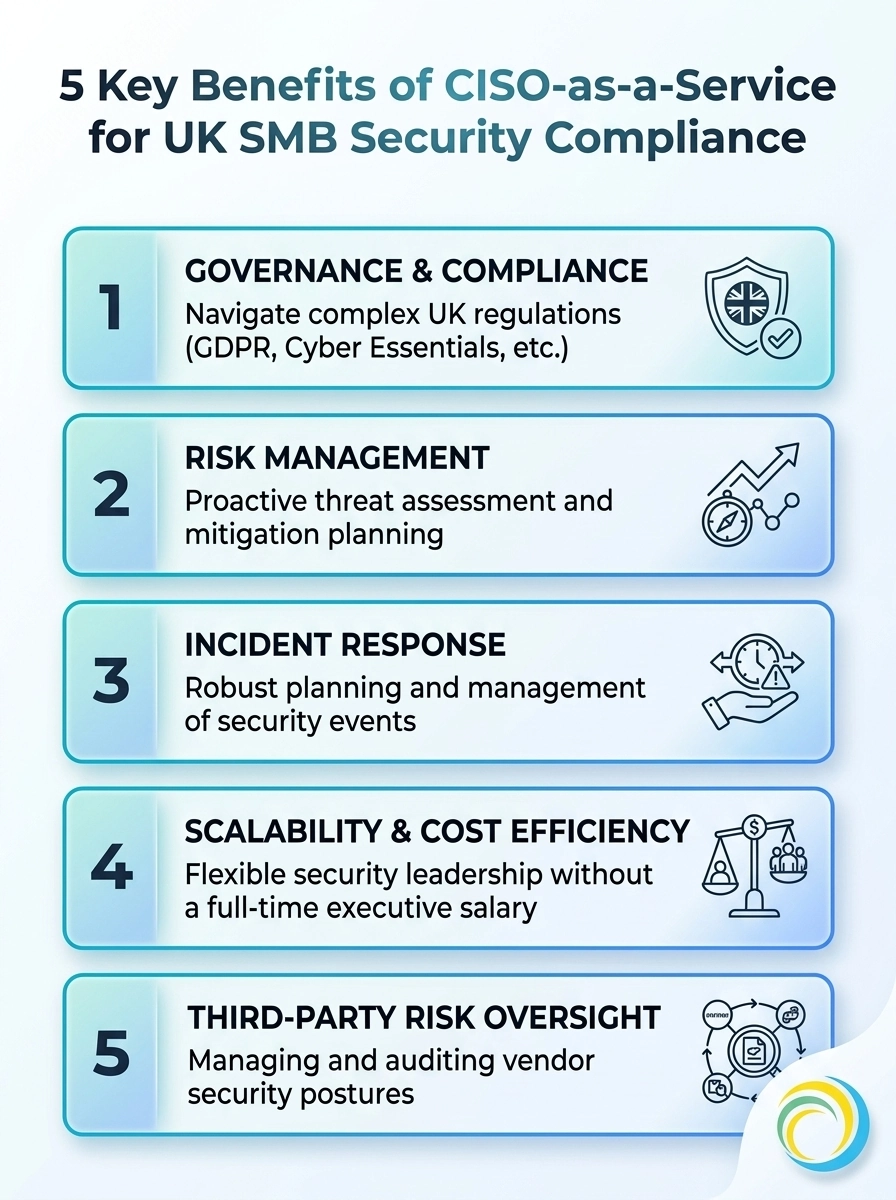
Discover the top 5 benefits of outsourcing a CISO for UK SMB security compliance. Learn how CISO-as-a-Service strengthens governance, risk management and regulatory readiness.
The Key Security Services That Work Alongside an Outsourced CISO for UK SMBs
A vCISO sets the strategy and governance direction, but security compliance also depends on the operational controls that sit underneath that strategy. For UK SMBs, the most impactful services to combine with an outsourced CISO engagement are:
- Security Operations Centre (SOC): 24/7 monitoring and rapid incident response, so that threats are detected and contained before they escalate into notifiable breaches.
- Identity and Access Management (IAM): Enforcing least-privilege access, MFA and single sign-on across your systems, which directly addresses the access control requirements in Cyber Essentials, UK GDPR and ISO 27001.
- Network Penetration Testing: Simulated attacks that validate whether your controls actually work, providing the kind of assurance evidence that auditors and board members need to see.
- Vulnerability Scanning: Continuous identification of weaknesses across your network and systems, feeding into the risk register that your vCISO maintains.
- Disaster Recovery: Tested recovery procedures with defined RPO and RTO targets, which satisfy both regulatory continuity requirements and the practical need to get back up and running without interruption after an incident.
- Endpoint Security: Protection for every device on your network, covering the malware protection and patching controls that sit at the heart of Cyber Essentials compliance.
The choice is straightforward: an outsourced CISO who also has access to these operational capabilities delivers a far more robust compliance outcome than a CISO working in isolation with no visibility of what the security tools are actually detecting day to day.
Hire an Outsourced CISO for UK SMB Security Compliance: What to Look for in a Provider
Not every vCISO provider is equal and for UK SMBs specifically, there are several factors worth considering carefully before making a decision.
UK regulatory knowledge: Your vCISO needs a genuine working understanding of UK GDPR, the ICO’s enforcement approach, Cyber Essentials certification requirements and sector-specific regulations relevant to your industry. Generic security leadership is not the same as UK compliance expertise.
Integration with your existing IT environment: A vCISO who works independently from your IT provider creates friction and gaps. Look for a provider who can integrate with your managed service partner, your Microsoft 365 environment and your existing security tooling.
Practical, not just theoretical: The value of a vCISO engagement is in the documentation, the evidence, the training records and the tested incident response procedures, not just a strategy presentation. Prioritise providers who can demonstrate measurable compliance outcomes from previous engagements.
Jargon-free communication: If your board can’t understand the security reports, the governance programme loses its value. The best vCISO providers communicate in plain business language, translating technical findings into clear priorities and decisions.
Scalability: Your compliance requirements will grow as your business grows. The right outsourced CISO partnership should scale with you, whether that means expanding into additional frameworks, supporting new acquisitions or adapting to changes in your supplier base.
How Hiring an Outsourced CISO Fits Into Your Broader UK SMB Security Compliance Programme

Hiring an outsourced CISO for UK SMB security compliance works best when it’s positioned as the strategic layer above your operational security controls. Think of it this way: your SOC monitors and responds, your IAM platform controls access, your endpoint security protects devices and your vCISO ties all of those functions together into a coherent, documented, auditable programme.
This integration is what transforms a collection of security tools into a genuine compliance posture. Regulators and auditors aren’t simply checking that you have the right software installed. They’re looking for evidence that your organisation has defined policies, that those policies are implemented consistently, that risks are tracked and reviewed and that your people know what to do when something goes wrong.
The DPO services that sit alongside a vCISO engagement are particularly relevant for UK SMBs handling personal data, because the Data Protection Officer and the CISO roles are closely connected in practice: the DPO manages the legal and regulatory dimension of data protection, while the CISO manages the technical and operational security controls that support it.
For businesses operating across multiple compliance frameworks simultaneously, the practical, realistic plan that a well-structured vCISO engagement produces becomes the single source of truth for your security programme, removing duplication, closing gaps and giving your team clear ownership of each control area.
The Business Case for UK SMBs: Outsourced CISO vs Full-Time Hire
The financial case for hiring an outsourced CISO for UK SMB security compliance is compelling. A full-time, experienced CISO in the UK market commands a salary in the range of £120,000 to £180,000 per year, before employer costs, benefits and recruitment fees. For most SMBs, that’s a significant proportion of their entire IT budget.
An outsourced CISO model delivers the same strategic leadership, the same compliance expertise and the same governance outcomes at a fraction of that cost, because you’re accessing a shared resource that brings experience across multiple industry verticals and regulatory environments, not just the experience of a single individual.
There’s also a resilience dimension worth considering. A full-time CISO who leaves takes their knowledge, their documentation and their relationships with them. A well-structured vCISO service maintains institutional knowledge within the provider’s team, so your compliance programme continues without interruption even if individual personnel change.
For SMBs in growth mode, the scalability of the outsourced model is equally important. As your business grows, your compliance obligations grow with it. The right vCISO partnership adapts to those changes naturally, without the delay and cost of recruiting a more senior internal hire.
Getting Started: What to Expect When You Hire an Outsourced CISO for UK SMB Security Compliance
Most vCISO engagements begin with a structured security review and compliance gap assessment. This gives both parties a clear picture of your current posture: what policies exist, what controls are in place, where the evidence gaps are and what the priority actions are to move toward compliance.
From that foundation, your vCISO builds out the governance programme in phases, typically prioritising the highest-risk gaps and the compliance requirements with the nearest deadlines. This phased approach means you see measurable progress quickly rather than waiting for a comprehensive programme to be fully built before anything improves.
Ongoing engagement typically involves regular risk reviews, policy updates, compliance reporting and coordination of any security incidents or near-misses that occur during the period. Your vCISO also acts as the primary point of contact for any regulatory enquiries or audit requests, so your internal team isn’t pulled into technical compliance discussions they’re not equipped to handle.
If your organisation would like to talk through how an outsourced CISO engagement could work for your specific compliance requirements, the team at ITERTECH is ready to help you cut through the complexity and build a practical, realistic plan with no obligation and no jargon.
The decision to hire an outsourced CISO for UK SMB security compliance is one of the most practical steps a growing business can take in 2026. With nearly half of UK businesses lacking the in-house cyber skills they need and only a quarter having a formal incident response plan in place, the gap between what regulators expect and what most SMBs can currently demonstrate is significant.
An outsourced CISO fills that gap directly: building the policies, managing the risks, coordinating the controls and producing the evidence that turns a collection of security tools into a genuine, auditable compliance programme. ITERTECH’s virtual CISO services are built specifically for UK SMBs, combining senior security leadership with the practical, jargon-free support that makes compliance achievable rather than overwhelming. Backed by a full suite of cyber security services, from SOC monitoring to identity management and penetration testing, ITERTECH gives your organisation the joined-up security function it needs to stay resilient, competitive and ready for what’s next.
Frequently Asked Questions
What is an outsourced CISO for UK SMB security compliance?
An outsourced CISO or virtual CISO (vCISO), is a contracted security leader who provides Chief Information Security Officer-level expertise to small and medium-sized businesses without the cost of a full-time hire. For UK SMBs, this typically means governance, risk management, compliance framework oversight and incident response planning delivered as an ongoing managed service.
Is it worth hiring an outsourced CISO for a small UK business in 2026?
Yes, particularly given the current regulatory environment. UK GDPR, Cyber Essentials and the expanding NIS2 framework all require formal security governance that most SMBs cannot sustain internally. Hiring an outsourced CISO for UK SMB security compliance delivers that governance at a cost that fits an SMB budget, while producing the documented evidence that auditors and regulators need to see.
How does a virtual CISO help with UK GDPR compliance?
A virtual CISO builds and maintains the documented security controls that support your UK GDPR obligations, including data processing records, breach notification procedures, privacy impact assessment processes and access control policies. They also coordinate with your Data Protection Officer to ensure the technical and legal dimensions of compliance are aligned.
What’s the difference between a CISO and a DPO for UK SMBs?
A CISO (Chief Information Security Officer) is responsible for the technical and operational security of your systems, data and infrastructure. A DPO (Data Protection Officer) manages the legal and regulatory compliance dimension of how you process personal data. For UK SMBs, both roles often work closely together and some providers, including ITERTECH, offer both functions as part of an integrated compliance programme.
How quickly can an outsourced CISO improve our compliance posture?
Most engagements begin with a gap assessment in the first two to four weeks, identifying the highest-priority compliance gaps and quick wins. Meaningful improvements to your documented posture, including risk registers, updated policies and incident response frameworks, typically begin to appear within the first 30 to 90 days of an active vCISO engagement.
Do I need an outsourced CISO if I already have an IT support provider?
Yes, these are complementary functions rather than overlapping ones. Your IT support provider keeps your systems running; your outsourced CISO for UK SMB security compliance ensures that how those systems are managed meets the governance, risk and compliance standards that your regulators, auditors and enterprise clients expect. The two roles work best when they’re integrated, not siloed.
What compliance frameworks does a UK virtual CISO typically cover?
A UK-focused vCISO typically covers Cyber Essentials and Cyber Essentials Plus, UK GDPR and the Data Protection Act 2018, ISO 27001 and sector-specific requirements relevant to your industry, such as PCI DSS for businesses processing card payments or HIPAA-equivalent frameworks for healthcare. As your business grows, the engagement adapts to include additional frameworks without requiring you to start from scratch.