

Choosing the best managed IT services for small UK businesses in 2026 has never been more important, with one alarming statistic making this crystal clear: 1 in 5 UK SMEs would be forced to permanently close their doors within three months if they experienced a major data breach. Technology is no longer a background function for small businesses, it is the backbone of daily operations, customer trust and long-term survival.
Key Takeaways
| Question | Answer |
|---|---|
| What are managed IT services? | Managed IT services involve outsourcing your IT infrastructure, support and security to a specialist provider, giving you proactive, ongoing management rather than reactive “break-fix” support. |
| How much do managed IT services cost in the UK in 2026? | Typical pricing for small UK businesses ranges from £30 to £65 per user per month, depending on the scope of services included. |
| Why do small UK businesses need managed IT services? | Small businesses face the same cyber threats as large enterprises but with fewer internal resources. A managed IT provider delivers enterprise-grade protection without the enterprise-level headcount. |
| What services should a good managed IT provider offer? | Core services include IT support, cloud management, cybersecurity, data security, network security, disaster recovery and business continuity planning. |
| Is it better to hire an in-house IT manager or use an MSP? | For most small UK businesses, an MSP delivers 70% to 80% in cost savings annually compared to a full-time IT manager, while providing broader expertise and 24/7 coverage. |
| What is the gold standard response time for UK MSPs in 2026? | According to Connection Technologies, top-performing UK MSPs now aim for a 15-minute response time for critical IT issues. |
| Where can I find managed IT services for small UK businesses? | Specialist providers like Itertech’s IT services offer fully managed packages tailored to SMEs across the UK. |
What Are Managed IT Services for Small UK Businesses in 2026?
Managed IT services refer to the practice of outsourcing the day-to-day management, monitoring and security of your business technology to a specialist provider called a Managed Service Provider (MSP). Rather than waiting for something to break before calling for help, an MSP takes a proactive approach, identifying and resolving issues before they impact your operations.
For small UK businesses in 2026, this model has become the standard choice for staying competitive, secure and operationally reliable. The best managed IT services for small UK businesses in 2026 combine remote monitoring, cloud management, cybersecurity and strategic IT guidance into a single, predictable monthly cost.

An MSP works as a direct extension of your business, not an external vendor you call in a crisis. This distinction is critical because it means your provider understands your infrastructure, your compliance obligations and your growth goals in the same way an internal IT team would.
The services covered under a managed IT contract typically include everything from helpdesk support and device management to advanced cybersecurity operations and cloud governance. We explore each of these in detail throughout this guide.
Why Small UK Businesses Are Turning to Managed IT Services in 2026
The pressure on small UK businesses to maintain secure, high-performing IT environments has never been greater. According to Fortray, 67% of UK SMEs plan to deepen their partnerships with Managed Service Providers in 2026 to improve cybersecurity and infrastructure scalability.
This shift reflects the growing complexity of modern IT environments. Hybrid working, cloud adoption, AI tools and increasingly sophisticated cyber threats have made it extremely difficult for small businesses to manage their technology in-house without specialist expertise.
The financial case is equally compelling. The break-fix model, where you only pay for IT support when something goes wrong, consistently proves more expensive and disruptive than a proactive managed approach. A single cyber incident or prolonged outage can cost far more than a year of managed IT fees.
Beyond cost, there is the question of expertise. A quality MSP brings a full team of specialists covering cloud infrastructure, security, compliance and support, giving small businesses access to skills that would cost significantly more to hire directly.
Did You Know?
SMEs can save between 70% and 80% annually by using a managed service provider compared to the cost of hiring a single full-time IT manager.
Source: Connection Technologies 2026
Best Managed IT Services for Small UK Businesses: Core Services to Look For
Not all managed IT providers offer the same depth of service. When evaluating the best managed IT services for small UK businesses in 2026, it is important to understand which core capabilities a provider must include to genuinely protect and support your operations.
The following is a structured breakdown of the essential services to look for:
- Managed IT Support: Proactive helpdesk, remote monitoring and device management for your entire user base.
- Cloud Services and Management: Governance, optimisation and security across platforms like Microsoft 365, Microsoft Azure and Google Cloud.
- Cybersecurity: Protection against phishing, malware, ransomware and other active threats, ideally backed by a Security Operations Centre.
- Data Security: Encryption, access controls and monitoring to prevent unauthorised access to sensitive business information.
- Network Security: Layered protection for your network infrastructure, including vulnerability detection and compliance support.
- Cloud Back-Up and Disaster Recovery: Rapid recovery capabilities that minimise downtime after outages or cyber incidents.
- Business Continuity Planning: Strategic planning to keep your business operational during and after major disruptions.
- CISO Services: Access to experienced security leadership and governance, without the cost of a full-time hire.
A provider that covers all of these areas delivers a genuinely comprehensive IT partnership. Missing even one of these components can leave significant gaps in your resilience and security posture.
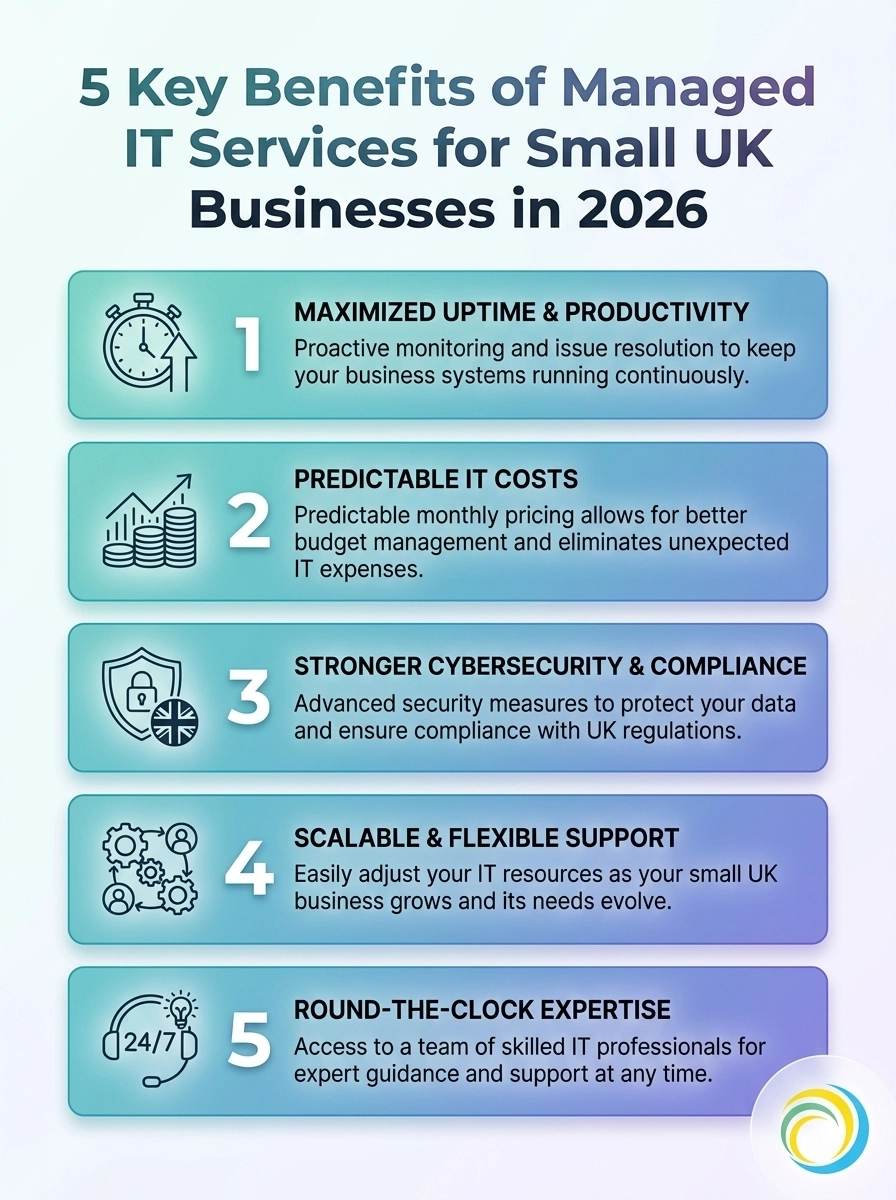
A quick snapshot of how managed IT services help small UK businesses in 2026. It highlights five key benefits, including cost savings, security and reliability.
Cloud Services and Cloud Back-Up for UK SMEs
Cloud infrastructure is now the foundation of IT operations for the vast majority of small UK businesses. Managed cloud services reduce or remove the reliance on costly on-premise hardware, improving resilience, scalability and remote access, while lowering dependence on local systems that can fail or be compromised.
A well-managed cloud environment covers platforms like Microsoft 365 and Microsoft Azure, ensuring your team always has secure, reliable access to the tools they need. Ongoing governance and optimisation mean you are not paying for capacity you do not use and your environment remains aligned with current security standards.
Alongside cloud management, cloud back-up is a non-negotiable component for any small business serious about continuity. Secure, versioned backups protect your data from accidental deletion, hardware failure and ransomware attacks, providing a clean recovery point when you need it most.
The combination of managed cloud services and automated back-up creates a stable, scalable foundation that supports business growth without the overhead of managing infrastructure internally.
Cybersecurity Services: Protecting Your Business from Modern Threats
Cybersecurity is no longer a concern reserved for large enterprises. According to CyberSecStats, 28% of UK SMEs admit that a single cyber attack could put them out of business entirely, making professional cybersecurity management an absolute necessity for small businesses in 2026.
The best managed IT services for small UK businesses in 2026 include a layered cybersecurity approach that addresses threats at every entry point. This means protection against phishing, malware, ransomware and credential theft, delivered through a combination of technology and human monitoring.
A comprehensive cybersecurity service typically includes endpoint protection, email security, security awareness training and access to a Security Operations Centre (SOC) for 24/7 threat monitoring. This level of coverage ensures that threats are identified and neutralised before they cause measurable damage to your business.
Additional components like multi-factor authentication and identity access management add critical layers of protection, particularly for businesses with remote or hybrid teams accessing sensitive systems from multiple locations.
According to SecurityBrief UK, 42% of UK SME owners cite cybersecurity concerns as the single greatest barrier to further digital transformation and innovation in 2026. A strong managed cybersecurity partnership removes that barrier entirely.
Network Security and Data Security for Small UK Businesses
A secure network is the infrastructure layer that keeps every other system and service protected. Proactive network security detects vulnerabilities early, reduces the risk of data breaches and downtime and helps businesses maintain compliance with UK data protection standards including UK GDPR.
Network security integrates with broader threat detection capabilities, including SIEM and SOAR platforms and vulnerability scanning, to give your provider full visibility across your environment. This layered approach is far more effective than relying on individual security tools in isolation.
Data security focuses specifically on protecting the information your business holds, covering access controls, encryption, monitoring and governance. For small businesses handling customer data, financial records or sensitive communications, a structured data security programme is both a legal obligation and a commercial imperative.
Together, network and data security form the protective core of any well-structured managed IT services engagement, ensuring that the systems your business relies on remain stable, compliant and resistant to both internal and external threats.
Disaster Recovery and Business Continuity: Why They Matter in 2026
Recovery capability is one of the most undervalued elements of managed IT services, until businesses need it. On average 92% of UK businesses require 24 hours or longer to recover from a significant IT outage or cyber incident without a structured recovery plan in place.
A professionally managed disaster recovery plan defines exactly how your systems and data will be restored after a major disruption, with clearly defined Recovery Time Objectives (RTOs) and Recovery Point Objectives (RPOs) that limit both downtime and data loss.
Business continuity planning takes this a step further by ensuring your entire operation, not just your IT systems, can keep functioning during a crisis. This includes communication plans, backup access methods and supply chain considerations that keep your business trading even when systems are under pressure.
For small UK businesses, having these plans in place and tested regularly is one of the most tangible ways managed IT services deliver real commercial value. The cost of downtime consistently outweighs the cost of prevention.
Did You Know?
The average small UK business loses approximately £7,500 per year due to unplanned IT downtime.
IT Support, CISO Services and Advanced Security Operations
Day-to-day IT support is the most visible element of managed IT services for small UK businesses. Responsive, knowledgeable IT support keeps your team productive, resolves technical issues quickly and provides the human interface between your business and your technology stack.
In 2026, the benchmark for critical issue response is 15 minutes, according to Connection Technologies. When evaluating providers, this is a concrete metric to ask about directly during your discovery conversations.
Beyond day-to-day support, CISO services provide small businesses with access to a Chief Information Security Officer on a fractional or fully outsourced basis. This delivers the security leadership, strategy and governance that was previously accessible only to large organisations with significant hiring budgets.
A virtual CISO aligns your technology decisions with your risk appetite, compliance requirements and commercial objectives. They define your security programme, provide board-level reporting and ensure your managed IT services remain strategically coherent as your business grows.
For businesses handling sensitive data, subject to industry regulations or seeking cyber insurance (which Heimdal Security reports 62% of UK small businesses now hold in 2026), CISO-level oversight is increasingly a practical requirement rather than a luxury.
Advanced security operations, including a Security Operations Centre and endpoint security, complete the picture by providing continuous monitoring and automated threat response across every device and user in your business.
How to Choose the Best Managed IT Services for Small UK Businesses in 2026
Selecting the right managed IT partner is one of the most strategically significant decisions a small business can make. The provider you choose will have direct access to your systems, data and business-critical infrastructure, so the evaluation process deserves serious attention.
The following criteria will help you identify the best managed IT services for small UK businesses in 2026:
- Breadth of Service: Confirm that the provider covers cloud management, cybersecurity, disaster recovery, data security and IT support, not just helpdesk services.
- Response Time SLAs: Ask for specific response time commitments for critical, high and standard issues. The 2026 benchmark for critical issues is 15 minutes.
- Security Credentials: Look for Cyber Essentials certification, ISO 27001 alignment and evidence of a structured security programme.
- Scalability: Your IT needs will grow. Choose a provider whose service tiers and pricing scale with your team and infrastructure without punishing you for growth.
- Proactive vs Reactive: Confirm that monitoring is continuous and that your provider will identify and address issues before they escalate, not wait for you to raise a ticket.
- Transparency and Reporting: Regular reporting, clear communication about incidents and honest conversations about your risk posture are all signs of a quality MSP partnership.
- Cultural Fit: Your managed IT provider will work closely with your team. Choose a partner who listens first and architects solutions around your specific goals and constraints.
It is also worth asking prospective providers how they stay current with emerging threats and technology trends. The best managed IT services for small UK businesses in 2026 come from providers who are continuously investing in their own capabilities.
What Does Managed IT Support Cost for UK Small Businesses in 2026?
Pricing transparency is important when comparing managed IT providers. According to Clyk Tech, managed IT services for small UK businesses in 2026 typically cost between £30 and £65 per user, per month, depending on the scope and depth of services included in the package.
This per-user pricing model makes costs predictable and directly tied to your headcount, which suits small businesses with stable team sizes as well as those in rapid growth phases.
| Service Tier | Typical Inclusions | Approx. Cost (Per User/Month) |
|---|---|---|
| Foundation | IT support, remote monitoring, basic security | £30 – £40 |
| Standard | Foundation + cloud management, endpoint security, cloud back-up | £40 – £55 |
| Advanced | Standard + cybersecurity, SOC, disaster recovery, CISO services | £55 – £65+ |
When you factor in the average £7,500 annual cost of unplanned downtime and the potential losses from a cyber incident, a fully managed IT services contract at these price points represents strong commercial value for most small UK businesses.
It is also worth considering the cost comparison to in-house hiring. A junior IT manager in the UK commands a salary of £35,000 to £45,000 per year and that investment provides only a fraction of the specialist coverage that a quality MSP delivers across cloud, security and infrastructure simultaneously.
Key Benefits of Managed IT Services for Small UK Businesses in 2026
Summarising the value that the best managed IT services for small UK businesses in 2026 deliver, the benefits fall into five clear categories:
- Cost Predictability: Fixed monthly pricing replaces unpredictable repair bills and emergency callout fees, making IT a budgeted operational cost rather than a financial surprise.
- Proactive Security: Continuous monitoring identifies and resolves threats before they cause damage, rather than responding after the fact when the cost is already incurred.
- Access to Specialist Expertise: A quality MSP gives small businesses access to cloud architects, security analysts and virtual CISOs that would be unaffordable to hire individually.
- Operational Resilience: With disaster recovery, business continuity and cloud back-up in place, your business can continue operating through disruptions that would otherwise cause significant downtime.
- Strategic Technology Guidance: The best MSPs act as strategic partners, helping you make informed technology decisions that support your business goals rather than simply reacting to technical problems.
“Proactive monitoring that stops problems before they start and a partnership built on transparency and trust, is what separates a genuine managed IT provider from a reactive break-fix service.”
For small UK businesses in 2026, these benefits are not aspirational, they are measurable, deliverable outcomes that a well-structured managed IT services engagement produces consistently.
Conclusion
The best managed IT services for small UK businesses in 2026 combine proactive support, enterprise-grade security, cloud management and strategic guidance into a model that is both commercially accessible and operationally transformative. The data is clear: small businesses that invest in professional IT management reduce downtime, strengthen security and free their leadership to focus on growth rather than technology problems.
Whether you are evaluating your first managed IT contract or looking to upgrade your current provider, the key is to choose a partner who genuinely understands your business, your risks and your ambitions. The best managed IT services for small UK businesses in 2026 are not simply technical support, they are a foundation for confident, resilient business growth.
Ready to explore what managed IT services can do for your business? Speak with the team at Itertech to find out how we can work as a direct extension of yours.
Frequently Asked Questions
What are the best managed IT services for small UK businesses in 2026?
The best managed IT services for small UK businesses in 2026 include a combination of proactive IT support, cloud management, cybersecurity, data security, disaster recovery and strategic security leadership through CISO services. Providers like Itertech offer all of these under a single managed contract, making it easier for small businesses to maintain a robust and resilient IT environment without building an internal team.
How much do managed IT services cost for a small UK business in 2026?
Managed IT services for small UK businesses in 2026 typically cost between £30 and £65 per user per month, depending on the scope of services included. This compares very favourably to the cost of hiring even a single in-house IT manager, which generally starts at £35,000 per year before benefits and overheads.
Is it worth getting managed IT services for a small business with fewer than 20 employees?
Yes, managed IT services are particularly valuable for very small businesses because the risk of a cyber incident or prolonged outage is proportionally more damaging at smaller scale. Even a business with five to ten employees benefits significantly from proactive monitoring, cloud back-up and cybersecurity services that a quality MSP provides.
What is the difference between managed IT services and IT support?
IT support typically refers to reactive helpdesk and break-fix services, where you contact a provider when something goes wrong. Managed IT services are broader and proactive, including continuous monitoring, security management, cloud governance and strategic planning, not just responding to problems after they occur.
How do I know if my current IT provider is actually protecting my business?
Ask your provider for evidence of continuous monitoring, a documented incident response plan and regular security reporting. If they cannot provide clear answers on response time SLAs, vulnerability scanning frequency or how they would recover your systems after a ransomware attack, it is time to evaluate alternative managed IT services providers.
What should I look for in a managed IT services contract for a UK small business?
Key elements to look for include clearly defined Service Level Agreements (SLAs), scope of services covering both support and security, disaster recovery provisions, cloud back-up arrangements and a dedicated point of contact. The best managed IT services contracts for small UK businesses in 2026 also include regular strategic reviews to ensure your IT environment evolves with your business.
Can a managed IT services provider help with UK GDPR compliance?
Yes, a quality managed IT provider will incorporate data security, access controls and audit capabilities that directly support your UK GDPR obligations. Services like identity access management, data security monitoring and vulnerability scanning all contribute to a compliance-ready IT environment that reduces your regulatory risk exposure.