

Business continuity and disaster recovery is no longer something you can afford to think about “later.” The average cost to recover from a single cyber security incident in the UK has reached £2.5 million as of 2026, and for small and medium-sized businesses operating on tighter margins, that figure alone should be enough to make resilience planning an immediate priority.
Key Takeaways
| BC/DR priority | Why it matters for UK businesses in 2026 |
|---|---|
| Continuity and recovery | Business continuity keeps operations running during a crisis; disaster recovery restores systems and data afterwards. |
| Downtime impact | Every minute of downtime costs money, productivity and reputation. |
| RTOs and RPOs | Recovery Time Objectives and Recovery Point Objectives define exactly how fast you recover and how much data you can afford to lose. |
| Testing | A plan that has never been tested is a plan that will likely fail when you need it most. |
| Cyber threats | Ransomware, phishing and data breaches can bring operations to a standstill in minutes. |
| Managed IT support | Partnering with a managed IT provider gives you proactive protection without the overhead of an in-house team. |
- Business continuity and disaster recovery (BC/DR) are two distinct but inseparable disciplines.
- A formal Business Continuity Plan is your first line of defence against downtime, data loss and reputational damage.
- RTOs and RPOs should guide every technical decision in your disaster recovery strategy.
- Cloud-based failover and secure backups are the foundation of modern disaster recovery services.
- Testing is non-negotiable, because assumptions collapse quickly during real incidents.
What Is Business Continuity and Disaster Recovery?
Business continuity and disaster recovery describe a set of strategies, processes and technologies that keep your business operational during unexpected disruptions and restore normal function afterwards.
Think of it this way: business continuity is about staying on your feet during a crisis, while disaster recovery is about getting back up if you fall.

The two work together. Your business continuity strategy ensures that essential services, communications and systems remain available when something goes wrong. Your disaster recovery plan then restores the full environment, including servers, data and applications, as quickly as possible.
Neither works without the other. A business that can keep operating during a crisis but cannot restore its data has only solved half the problem.
Why Business Continuity and Disaster Recovery Is Critical in 2026
The threat landscape has never been more complex. Ransomware attacks, supply chain failures, power outages, hardware failures and even severe weather events can bring your IT infrastructure to a complete standstill.
In 2026, the question is not whether your business will face a disruption. It is how prepared you are when it happens.
For small and medium-sized businesses across London and Surrey, the stakes are particularly high. Without the enterprise-level IT teams that larger organisations rely on, a single unplanned outage can cascade quickly into lost contracts, regulatory penalties and lasting reputational damage.
At ITERTECH, we take the stress out of IT for businesses exactly like yours. We provide proactive solutions designed to protect you before disaster strikes, not just clean up after it.
Business Continuity Planning: What a Strong BC Plan Must Include
A solid business continuity plan is not a single document gathering dust in a shared drive. It is a living, tested framework that your team can act on immediately when the unexpected happens.
Here is what every effective BC plan must cover:
- Business Impact Analysis (BIA): a clear picture of which systems, processes and data are mission-critical and what the cost of losing each one looks like.
- Defined Recovery Priorities: not everything can be restored at once. Your plan must rank systems by criticality so your team knows what to tackle first.
- Communication Protocols: who calls whom, through which channels and when. Staff, clients and suppliers all need to know what is happening.
- Documented Procedures: step-by-step guidance for every likely scenario, written clearly enough that anyone on your team can follow them under pressure.
- Regular Testing and Review: at minimum annually, and after any significant change to your IT environment or business structure.
- Roles and Responsibilities: every person named in the plan must know their role in advance, not discover it mid-crisis.
Our Business Continuity Plan service covers all of this, giving you a formal, tested and actionable plan that protects revenue and reputation when it matters most.

Business Continuity and Disaster Recovery in the Age of AI
Modern business continuity is no longer just about keeping the lights on after a server failure. It has become the foundation for every other technology initiative your business is running, including AI.
As the statistic above makes clear, AI projects without resilient data management behind them are built on sand. If your data is unprotected, poorly backed up or inaccessible after a disruption, your AI tools are the first thing to fail.
That means your business continuity and disaster recovery strategy now directly determines whether your investment in automation, machine learning and intelligent workflows actually delivers results or quietly collapses.
We help businesses build the data foundations that make every future technology investment more secure. It is proactive solutions thinking, not just reactive firefighting.
Disaster Recovery Solutions: Understanding RTOs and RPOs
If you have ever spoken to an IT provider about disaster recovery, you will have heard the terms RTO and RPO. Here is what they actually mean in plain language.
Recovery Time Objective (RTO) is the maximum amount of time your business can tolerate being offline. If your RTO is four hours, your disaster recovery plan must be capable of restoring your systems within that window.
Recovery Point Objective (RPO) is the maximum amount of data loss your business can accept, measured in time. If your RPO is one hour, your backups must run at least every hour so that no more than 60 minutes of data is ever at risk.
Together, RTOs and RPOs guide every technical decision in your disaster recovery plan, from how frequently backups run to which failover systems you invest in.
Practical rule: define your RTOs and RPOs before you choose the technology, because the numbers should shape the solution, not the other way around.
Getting these numbers wrong, or not defining them at all, is one of the most common and costly mistakes we see businesses make. The time to define them is now, before a crisis forces the question.
The Best Disaster Recovery and Business Continuity Technologies for 2026
The technology stack behind an effective business continuity and disaster recovery solution has evolved significantly. Here are the core components every business should understand:
- Cloud Backups: automated, encrypted backups stored off-site in secure cloud environments. These protect your data from local hardware failure, fire, flood and ransomware in a single solution.
- Failover Systems: secondary servers or cloud instances that can take over from your primary systems within minutes if they go offline. Near-instant transition means your team barely notices the interruption.
- 24/7 Health Monitoring: continuous monitoring of your IT infrastructure to identify and remediate potential issues before they escalate into full outages.
- NAS (Network Attached Storage) Devices: on-premise backup solutions that provide fast local recovery alongside your cloud strategy, giving you a double layer of protection.
- Disaster Recovery Testing: scheduled failover tests that prove your systems work exactly as planned, every single time, not just in theory.
- Encrypted Data Transfer: all backup data should be encrypted in transit (TLS/SSL) and at rest (AES-256), using the same technology that militaries around the world rely on daily.
We implement and manage all of these technologies as part of our Business Continuity and Disaster Recovery services, giving you a fully integrated solution rather than a patchwork of disconnected tools.
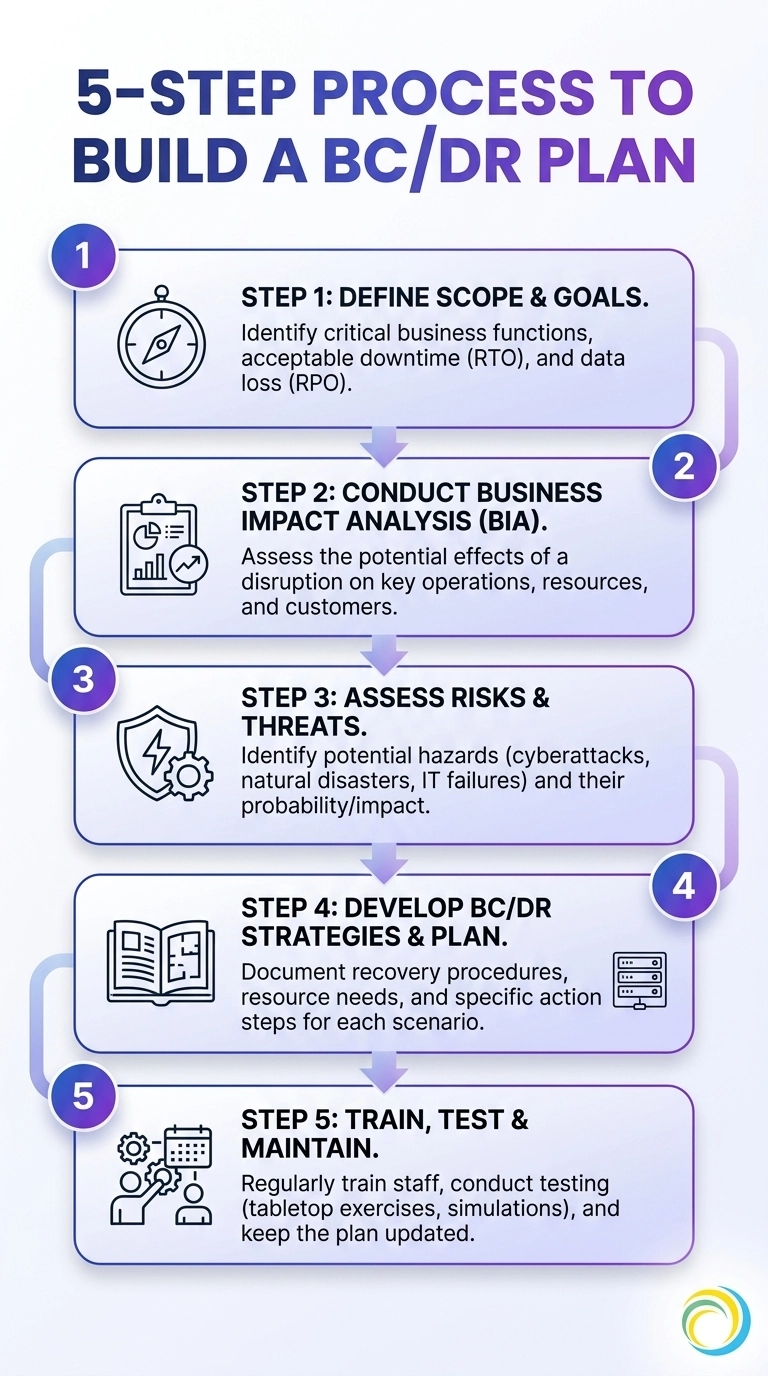
This infographic breaks down the 5 steps to build a robust Business Continuity and Disaster Recovery plan. It highlights actionable steps to improve resilience.
Business Continuity and Disaster Recovery Against Cyber Threats
Ransomware is now one of the most common triggers for a business continuity and disaster recovery activation. Attackers do not just steal your data. They encrypt it, lock you out of your own systems and demand payment before you can operate again.
Without a tested DR plan and secure off-site backups, your options in that moment are grim: pay the ransom, or rebuild from scratch.
With the right protections in place, the calculus changes entirely. Clean, recent backups stored separately from your network mean you can restore to a point before the attack, without paying a penny to the people who targeted you.
Our cybersecurity services for businesses work hand in hand with our BC/DR offering, ensuring that your defences and your recovery capabilities are always aligned.
How Long Could Your Business Survive a Three-Hour Outage?
Over three hours offline. For many businesses, that is not just an inconvenience. It is a crisis.
Consider what stops working in that window: customer orders, internal communications, access to files, payment processing, CRM systems and the ability of your team to do their jobs at all. Every minute of that window is a direct cost to your bottom line and a risk to your client relationships.
The businesses that weather these events calmly, effectively and efficiently are not the ones that got lucky. They are the ones that planned ahead, tested their systems and had the right IT partner behind them.
This is exactly why we build business continuity and disaster recovery solutions with clearly defined RTOs, tested failover systems and 24/7 monitoring. By the time most teams realise something has gone wrong, we are already resolving it.
Business Continuity and Disaster Recovery for Small and Medium-Sized Businesses
A common misconception is that robust BC/DR planning is only for large enterprises with dedicated IT departments and big budgets. That is simply not true in 2026.
Cloud technology has levelled the playing field significantly. The same enterprise-grade backup, failover and monitoring capabilities that large organisations depend on are now accessible to businesses of any size, at a fraction of the historical cost.
What smaller businesses often lack is not budget. It is time, internal expertise and a clear starting point. That is exactly where a managed IT partner makes all the difference.
Through our outsourced IT support, we act as your dedicated IT team, handling your BC/DR planning, implementation and testing alongside every other aspect of your IT environment. You get peace of mind and a full solution without the overhead of an in-house hire.
What to Look for in a Business Continuity and Disaster Recovery Partner
Not all managed IT providers approach business continuity and disaster recovery the same way. Here is what you should expect from any provider you consider:
- Proactive monitoring, not just reactive support. Your provider should be identifying risks before they become outages, not just responding after the damage is done.
- Defined and documented RTOs and RPOs. Vague promises about “fast recovery” are not a plan. You need specific, measurable objectives written into your agreement.
- Regular, evidenced testing. Any provider worth trusting will test your failover systems on a schedule and show you the results.
- Jargon-free communication. You should always understand what is being protected, how and why. If your provider cannot explain it plainly, that is a problem.
- Clear escalation paths. When something goes wrong, you need to know exactly who to call and what happens next, not discover it mid-crisis.
- A track record you can verify. Case studies, client references and real-world outcomes matter far more than glossy brochures.
We pride ourselves on being the reliable, behind-the-scenes IT heroes our clients count on. You can read about the real-world outcomes we have delivered on our IT case studies page.
How ITERTECH Delivers Business Continuity and Disaster Recovery
At ITERTECH, we handle everything, from IT support and cloud services to cybersecurity, network management and much more, so you can focus on running your business, not fighting tech issues.
Our approach to business continuity and disaster recovery is built around four pillars:
- Assessment and Planning: we start by understanding your business, your critical systems and your risk tolerance. We then build a formal BC/DR plan that reflects your actual operations, not a generic template.
- Implementation: we deploy the right combination of cloud backups, failover systems, monitoring and security controls to match your defined RTOs and RPOs.
- Testing: we test regularly and document the results so you always know your plan works. No surprises. No assumptions.
- Ongoing Management: as your business evolves, so does your BC/DR plan. We review and update it continuously so it stays relevant and effective.
We work with businesses across London, Surrey and beyond, and we bring the same level of care, expertise and responsiveness to every single client. It is technology you can trust, and a partnership you will love.
Business Continuity and Disaster Recovery Is Not Optional in 2026
Business continuity and disaster recovery has moved from a “nice to have” to a fundamental requirement for any business that relies on technology to operate, which in 2026 means virtually every business in the UK.
The costs of getting it wrong, measured in downtime, data loss, regulatory exposure and reputational damage, far exceed the investment required to get it right. And with cloud-based solutions making enterprise-grade protection more accessible than ever, there is no longer a size threshold below which BC/DR planning does not apply.
Whether you are building your first formal plan or reviewing an existing one, the time to act is now. At ITERTECH, we are here to guide you every step of the way with clear communication, proactive solutions and jargon-free support that gives you real peace of mind.
Get in touch with our team today and let us build a business continuity and disaster recovery solution that works for your business, your budget and your ambitions.
Frequently Asked Questions
What is the difference between business continuity and disaster recovery?
Business continuity focuses on keeping essential operations running during a disruption, while disaster recovery focuses on restoring IT systems and data after a disruption has occurred. Both disciplines are part of an effective BC/DR strategy and work together to minimise downtime and data loss.
How much does a business continuity and disaster recovery plan cost for a small business in the UK?
The cost of a BC/DR solution varies depending on the size of your business, the complexity of your IT environment and the recovery objectives you define. For most small and medium-sized businesses, managed BC/DR services are available at a monthly cost far lower than the potential cost of a single unplanned outage, which can run into tens of thousands of pounds for even a brief disruption.
How often should a disaster recovery plan be tested?
A disaster recovery plan should be tested at least once a year, and additionally after any significant change to your IT infrastructure, business processes or staffing. Regular testing is the only way to confirm that your failover systems, backups and recovery procedures will work as expected when a real incident occurs.
What are RTO and RPO in disaster recovery, and why do they matter?
RTO (Recovery Time Objective) is the maximum acceptable time your systems can be offline before the impact becomes unacceptable. RPO (Recovery Point Objective) is the maximum acceptable amount of data loss, measured in time. These two metrics drive every technical decision in a disaster recovery plan and must be defined before any solution is designed or deployed.
Is business continuity and disaster recovery only relevant for large companies?
No. In 2026, businesses of any size face the same range of threats, including ransomware, hardware failure and human error, and the financial and reputational consequences of prolonged downtime can be proportionally more severe for smaller organisations. Cloud-based BC/DR solutions have made enterprise-grade protection accessible to businesses at every scale.
What happens to my business if I do not have a disaster recovery plan?
Without a disaster recovery plan, your business faces an uncontrolled response to any IT incident, meaning longer downtime, greater data loss and significantly higher recovery costs. Research indicates that the average service disruption lasts over three hours even for businesses with some level of preparation; without a plan, that window extends considerably and the outcomes are far less predictable.
How do I start building a business continuity and disaster recovery plan?
The best starting point is a Business Impact Analysis (BIA), which maps your critical systems, processes and the cost of losing each one. From there, you define your RTOs and RPOs, document your recovery procedures, assign responsibilities and schedule regular testing. Working with a managed IT provider like ITERTECH means you have expert guidance throughout the entire process, from the first conversation to ongoing plan management.